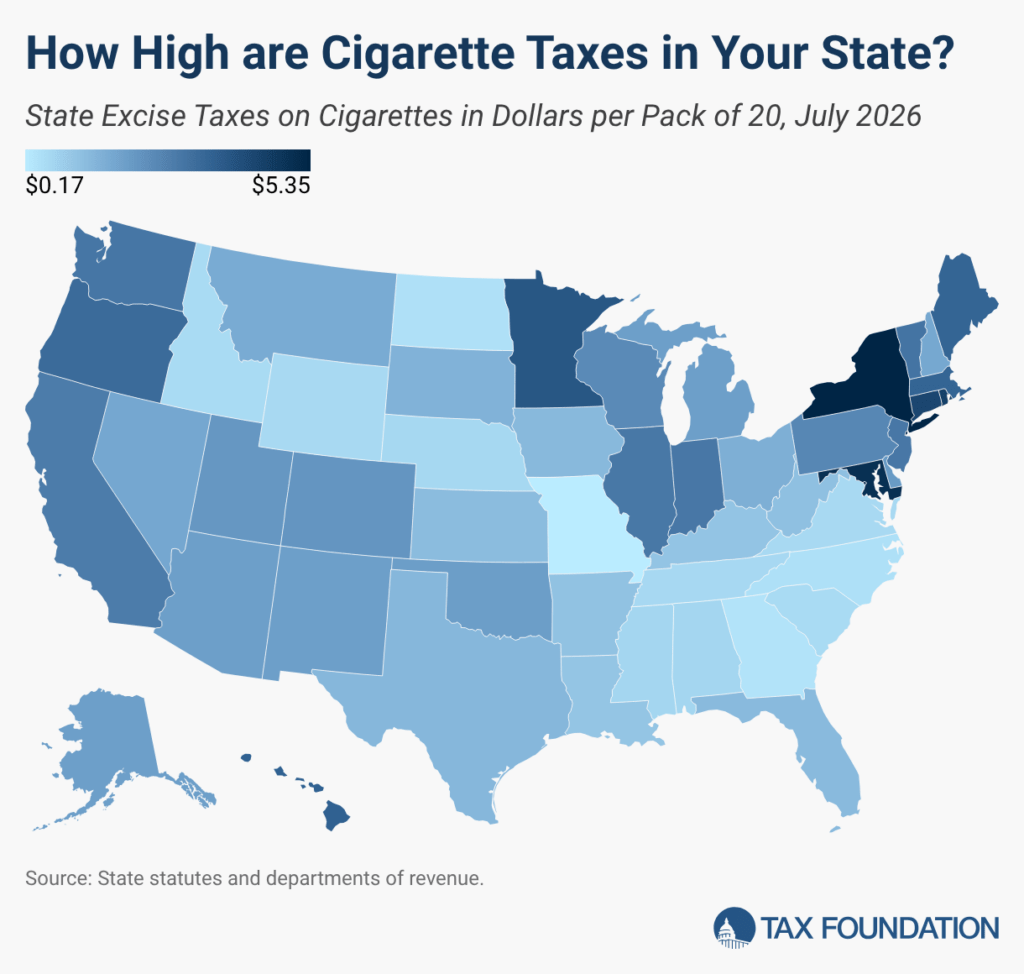
Cigarette excise taxes in the United States vary dramatically by state. In July 2026 the statutory rate ranges from $0.17 per pack in Missouri to $5.35 per pack in New York, creating large differences in the share of retail price that comes from tax, the regressive impact on low‑income smokers, and incentives for cross‑border or illicit purchases.
State tax rates (per pack of 20 cigarettes)
| Rank | State | Tax ($) |
|---|---|---|
| 1 | New York | 5.35 |
| 2 | District of Columbia | 5.07 |
| 3 | Maryland | 5.00 |
| 4 | Rhode Island | 4.50 |
| 5 | Connecticut | 4.35 |
| … | … | … |
| 46 | Virginia | 0.60 |
| 47 | Wyoming | 0.60 |
| 48 | North Dakota | 0.44 |
| 49 | Georgia | 0.37 |
| 50 | Missouri | 0.17 |
The lowest‑tax states after Missouri are Georgia ($0.37), North Dakota ($0.44) and North Carolina ($0.45).
Recent notable tax changes (effective 2024‑2026)
- Indiana – July 1 2025: tax tripled from $0.995 to $2.995 per pack.
- Maine – Jan 5 2026: increased from $2.00 to $3.50.
- Hawaii – Jan 1 2026: raised from $3.20 to $3.60.
- New Jersey – Aug 1 2025: rose from $2.70 to $3.00.
- Rhode Island – Sep 1 2024: lifted from $4.25 to $4.50.
- Minnesota – Jan 1 2026: automatic adjustment raised the rate from $3.826 to $3.88.
- District of Columbia – Oct 1 2025: surtax increased from $5.03 to $5.07.
- Utah – July 1 2026: tax increased from $1.70 to $2.20.
Federal excise tax
All states add the federal excise tax of $1.01 per pack to their own rates, so the total tax burden on a pack in New York, for example, is $6.36.
Share of retail price
According to the latest Orzechowski‑Walker data, excise taxes accounted for 31.1 % of the average retail price of cigarettes in 2025. The share ranged from:
- 14.7 % in Missouri (lowest)
- 44.8 % in Maryland (highest)
These percentages exclude any state sales taxes or local levies that may be added on top of the excise tax.
Revenue volatility
Cigarette tax revenues are highly volatile because the tax base—total packs sold—has been shrinking as smoking prevalence declines. States that rely heavily on these revenues face:
- Short‑term spikes after tax hikes, followed by accelerated revenue declines as higher prices suppress consumption.
- Erosion of real revenue value due to inflation.
Historically, every state’s cigarette‑tax revenue has shown notable fluctuations.
Regressivity
Excise taxes on cigarettes are among the most regressive taxes measured:
- New York has the most regressive state cigarette tax; the effective tax rate for the lowest income quintile is 22.2 times that of the highest quintile.
- Utah is the least regressive, with the lowest‑quintile rate 11.2 times the highest‑quintile rate.
At the federal level, the top 10 % of earners paid 18.9 % of tobacco excise taxes in 2023, compared with 32.2 % of alcohol excise taxes.
Cross‑border and illicit trade
Large tax differentials create incentives for smuggling and cross‑state purchases:
- More than 1.5 billion packs are estimated to be smuggled annually in the United States.
- A price gap of roughly $4.40 per pack (e.g., Maryland vs. Virginia) can drive consumers to shop across state lines.
- Prohibitive policies such as flavor bans can further push smokers toward illicit markets, undermining both public‑health goals and legitimate tax revenues.
International comparison
The European Union’s minimum cigarette excise tax of $2.11 per pack would rank 19th among U.S. states, while New York’s $5.35 rate would place it around 7th highest among EU countries.
Policy implications
- Revenue reliability: Because cigarette‑tax receipts decline as smoking falls and are subject to illicit diversion, they are a poor foundation for funding general government services.
- Equity concerns: The strong regressivity suggests that cigarette taxes should be paired with measures that offset the disproportionate burden on low‑income households.
- Rate setting: Policymakers need to balance public‑health objectives with the risk of encouraging cross‑border purchases or illicit trade; excessively high rates may backfire by shifting sales out of the taxed jurisdiction.
Overall, while cigarette excise taxes remain a tool for discouraging smoking and generating revenue, their volatility, regressivity, and susceptibility to smuggling limit their suitability as a primary source of stable public‑finance.
Source article: taxfoundation.org




