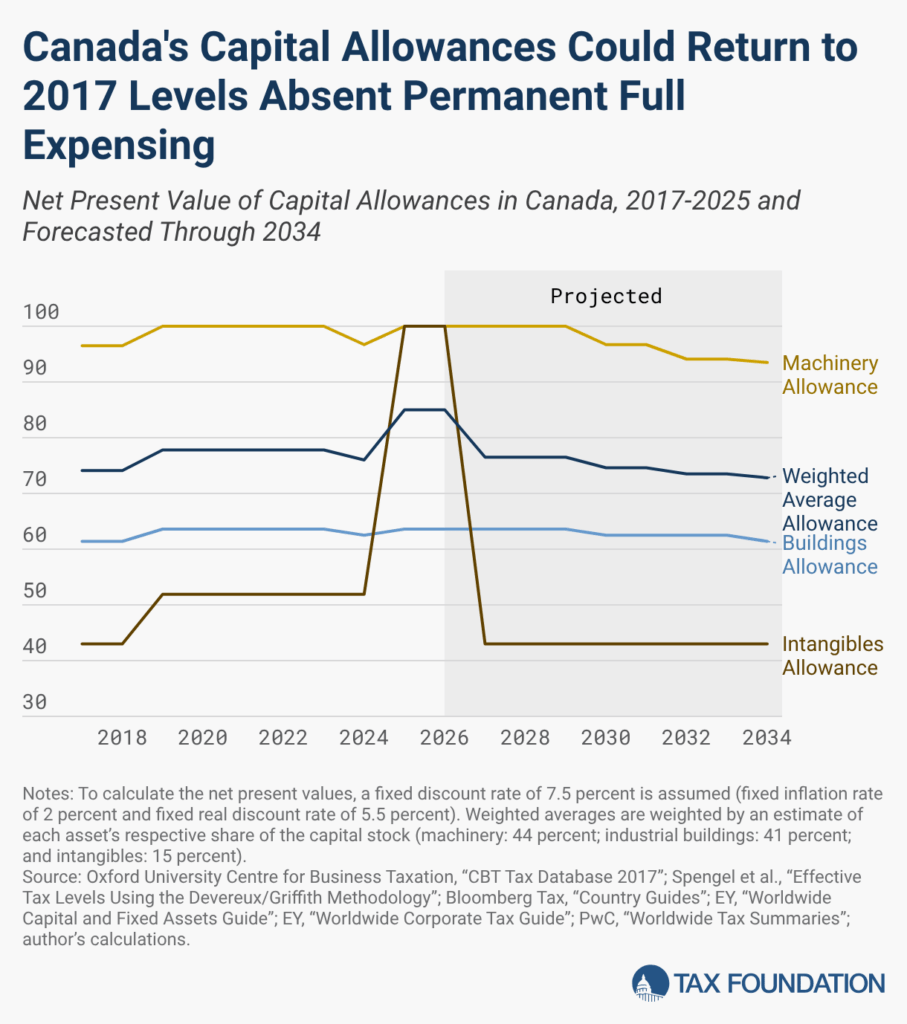
Canada’s capital‑allowance rules have shifted repeatedly since the 2018 adoption of temporary full expensing for equipment, machinery, and certain clean‑energy investments. With the 2025 budget delayed after spring‑2025 snap elections, the government is again considering whether to make these accelerated deductions permanent.
Recent temporary measures
- 2018 – Canada introduced temporary immediate expensing for manufacturing and processing equipment and for qualified clean‑energy projects, plus accelerated depreciation for non‑residential buildings and intangible assets.
- 2024 – The provisions began to phase out but were reinstated in 2025.
- 2025‑2029 – Immediate expensing remains in effect for eligible assets.
- 2030‑2033 – The policies will be gradually phased out. Specific phase‑out schedules include:
- First‑year write‑off for manufacturing/processing buildings falls from 15 % (2025) to 10 % (2034).
- First‑year write‑off for other non‑residential buildings drops from 9 % to 6 %.
- Equipment and machinery deduction declines from 100 % (2025) to 93.5 % (2034) in net‑present‑value terms.
- Intangible‑asset recovery is projected to be the second‑lowest among OECD members by the end of 2027, at 43 %.
- Overall, the share of capital investments that can be deducted across all asset types falls from 85 % (2025) to 72.8 % (2034).
Legislative outlook
- Bill C‑31 (second reading in the Senate) would extend immediate expensing to manufacturing and processing buildings acquired on or after 4 Nov 2025.
- The government has launched public consultations ahead of the 2026 budget, providing an opening to codify permanent full expensing for machinery and equipment.
Arguments for permanent full expensing
- Maintain Canada’s OECD ranking – Currently ranked 5th in capital cost recovery, Canada would slip to 12th by 2034 if the temporary measures expire.
- Fiscal impact – Accelerated depreciation mainly shifts deductions forward; the peak cost to the Treasury occurs in the early years of implementation, after which the nominal cost declines.
- Economic benefits – U.S. experience after the 2017 Tax Cuts and Jobs Act shows that making full expensing permanent is projected to raise GDP by 0.6 % and increase the capital stock by 1 % over the long run.
- Investment incentives – Permanent immediate deductions lower the effective cost of capital, encouraging firms to invest in new equipment, machinery, and structures, which can boost productivity, wages, and job creation.
Comparison with the United States
- The U.S. adopted bonus depreciation in 2017, began phasing it out in 2023, and made full expensing permanent in 2025.
- Temporary 100 % expensing for qualifying industrial structures (construction start 19 Jan 2025 – 31 Dec 2028, placed in service before 1 Jan 2031) covers roughly 10‑15 % of U.S. industrial buildings.
- These measures lifted the U.S. from 21st to 3rd place among OECD countries in capital cost recovery.
Policy recommendations
- Enact permanent immediate expensing for machinery and equipment as a core feature of the tax code.
- Extend permanent full expensing to manufacturing and processing buildings once the Bill C‑31 provisions are finalized.
- Incorporate inflation adjustments into capital‑allowance schedules to preserve the real value of deductions over time.
By converting temporary accelerations into permanent provisions, Canada can sustain its competitive position in the OECD, lock in the fiscal savings already realized, and promote a more robust, long‑term investment climate.
Source article: taxfoundation.org





