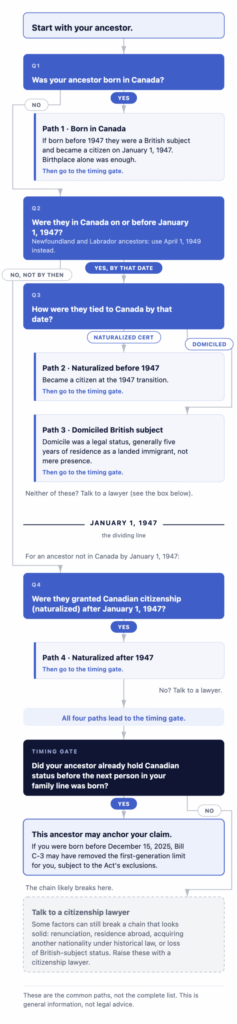
Canadian citizenship by descent does not require a “born‑in‑Canada” ancestor. The link can come from several historical routes, each dependent on the legal status of the ancestor at the time the next generation was born.
How an ancestor can become the “Generation Zero” link
-
Born in Canada before 1 January 1947
- Before the Citizenship Act took effect, people born in Canada were British subjects, not Canadian citizens.
- The current Citizenship Act treats that pre‑1947 British‑subject status as a valid starting point for a citizenship‑by‑descent claim.
-
Naturalized in Canada before 1 January 1947
- Immigrants who obtained British‑subject status through naturalization before the Act are treated like pre‑1947 native‑born British subjects.
- Proof of naturalization before the ancestor left Canada is required; the absence of a citizenship certificate can make verification difficult.
-
British subject residing in Canada on 1 January 1947
- Domicile, not mere presence, is required—generally five years of residence as a landed immigrant.
- Such an ancestor, even if born elsewhere, qualifies if they held Canadian domicile on the cutoff date.
-
Naturalized or granted citizenship after 1 January 1947
- Any immigrant who became a Canadian citizen after the Citizenship Act can serve as Generation Zero, provided the citizenship was effective before the birth of the next generation.
- Example: Tomasz Kowalski immigrated in 1968, naturalized in 1974, and his daughter Maria (born 1980) could inherit citizenship because Tomasz was already a citizen at her birth.
Special regional consideration
- Newfoundland and Labrador joined Confederation on 31 March 1949. Ancestors from that province become Canadian citizens on that later date, not on 1 January 1947. Claims must be assessed against the 1949 cutoff.
Factors that can break the chain
- Renunciation of Canadian citizenship
- Acquisition of another nationality under historic laws that caused loss of British‑subject status
- Residence abroad that triggered loss of status
- Failure to prove the ancestor held Canadian status before the birth of the next generation
Any of these issues can invalidate an otherwise solid‑looking lineage.
Practical steps for a citizenship‑by‑descent claim
- Document the ancestor’s status: naturalization certificates, citizenship certificates, or proof of domicile (e.g., immigration records, long‑form birth certificates showing parentage).
- Establish the timeline: verify that the ancestor’s Canadian status was in force before the birth of the subsequent generation.
- Gather supporting records: long‑form birth certificates for each link in the chain, marriage certificates if name changes occurred, and any missing official documents through an IRCC records search.
- Check for exclusions: be aware of statutory limits such as the 2025 amendment (Bill C‑3) that may affect descendants born after a certain date.
Visual overview
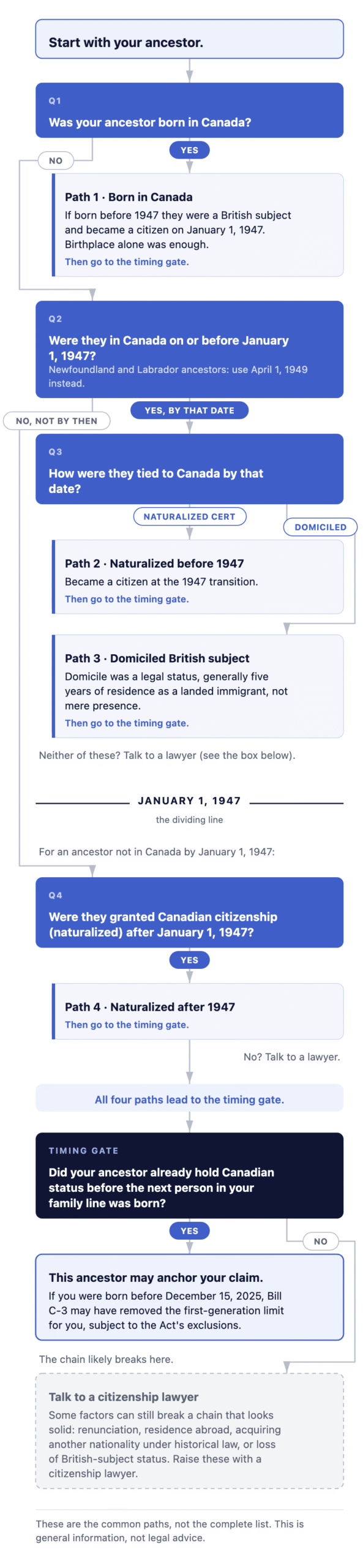
Understanding these pathways helps families determine whether they have a viable claim to Canadian citizenship by descent, even when no ancestor was born on Canadian soil.
Source article: www.cicnews.com





