Grenada’s citizenship‑by‑investment program delivers a bundle of legal rights that go far beyond a travel document. The core advantages include eligibility for the U.S. E‑2 treaty investor visa, a territorial tax regime, automatic transmission of nationality to descendants, and regional mobility within the Eastern Caribbean.
U.S. E‑2 Treaty Investor Visa
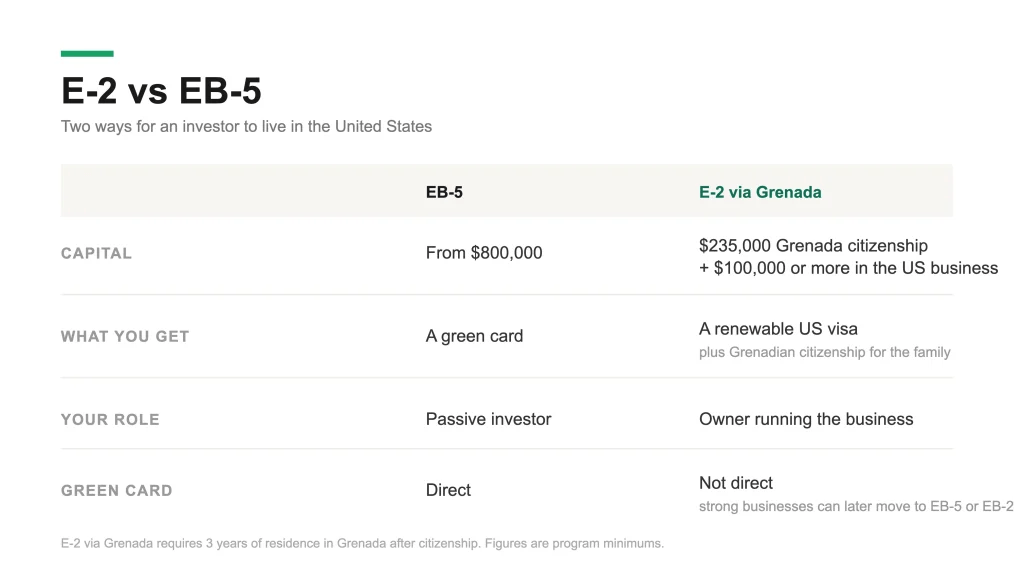
- Grenadian citizens are the only Caribbean investors who qualify for the U.S. E‑2 visa under the 1987 U.S.–Grenada treaty of commerce.
- The visa permits the holder and a spouse to live in the United States while directing a bona‑fide business; the spouse may also work.
- No statutory minimum investment is required, but attorneys typically advise a commitment of US $100,000 or more to a credible enterprise.
- By contrast, the U.S. EB‑5 program requires a minimum investment of US $800,000.
- A typical pathway combines a Grenada CBI contribution of US $235,000 with the E‑2 qualifying investment, providing a second passport and a renewable U.S. residence option for well under half the capital needed for EB‑5.
The 2022 AMIGOS Act introduced a three‑year continuous domicile requirement in Grenada for applicants who obtained citizenship through investment before they can apply for an E‑2 visa. Domicile entails actual residence, local financial activity, and sustained presence on the island. Spouses who acquire Grenadian citizenship through marriage are not subject to this rule.
The E‑2 visa is a non‑immigrant status: it can be renewed indefinitely while the business operates but does not itself lead to a green card. Time spent in E‑2 status does not count toward permanent residence, making the route most suitable for entrepreneurs who may later transition to EB‑5 or an EB‑2 National Interest Waiver if their business creates sufficient jobs or economic value.
Tax Residence Flexibility
Grenada operates a territorial tax system:
- No tax on worldwide income, capital gains, inheritance, estate, or wealth.
- Citizens who never reside on the island owe no Grenadian taxes.
If a citizen chooses to become a tax resident—generally by spending at least 183 days per year in Grenada—only Grenadian‑source income becomes taxable locally. This optional tax residence provides a low‑tax environment that can be adopted or abandoned as personal circumstances change.
Generational Citizenship
- Citizenship is permanent and does not expire; the passport must be renewed every five years, but the nationality endures.
- Children born to Grenadian citizens acquire citizenship automatically by descent, and the right passes to grandchildren and subsequent generations without any residency requirement.
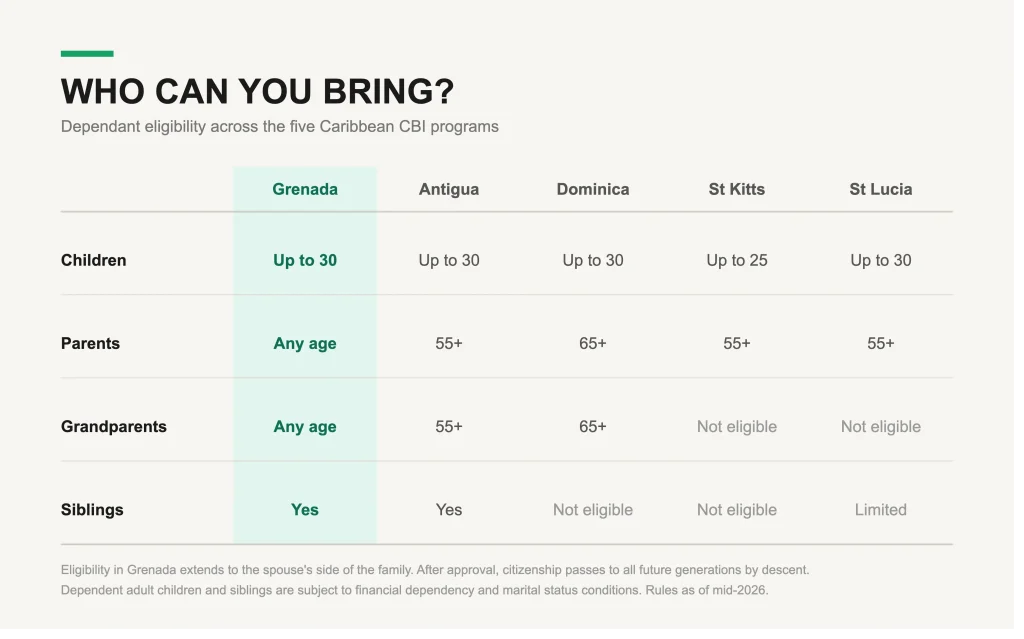
- A single application can include dependants, children up to age 30, parents, grandparents, and unmarried siblings, allowing three generations to obtain citizenship simultaneously.
Regional Mobility
Grenadian citizens are also members of the OECS Economic Union, granting the right to live, work, and establish residence in any Eastern Caribbean state without a visa, permit, or skills certificate. Broader CARICOM membership extends similar rights across the Caribbean community, providing a regional footprint beyond Grenada itself.
Shifting Industry Focus
Investment‑migration programs are moving from a focus on passport “perk” lists toward the substantive legal status and its long‑term planning implications. Grenada’s model—linking the E‑2 visa to genuine domicile, offering optional tax residence, and enabling automatic generational transmission—aligns with this emerging emphasis on real ties and obligations rather than merely visa‑free travel.
Source article: www.imidaily.com



