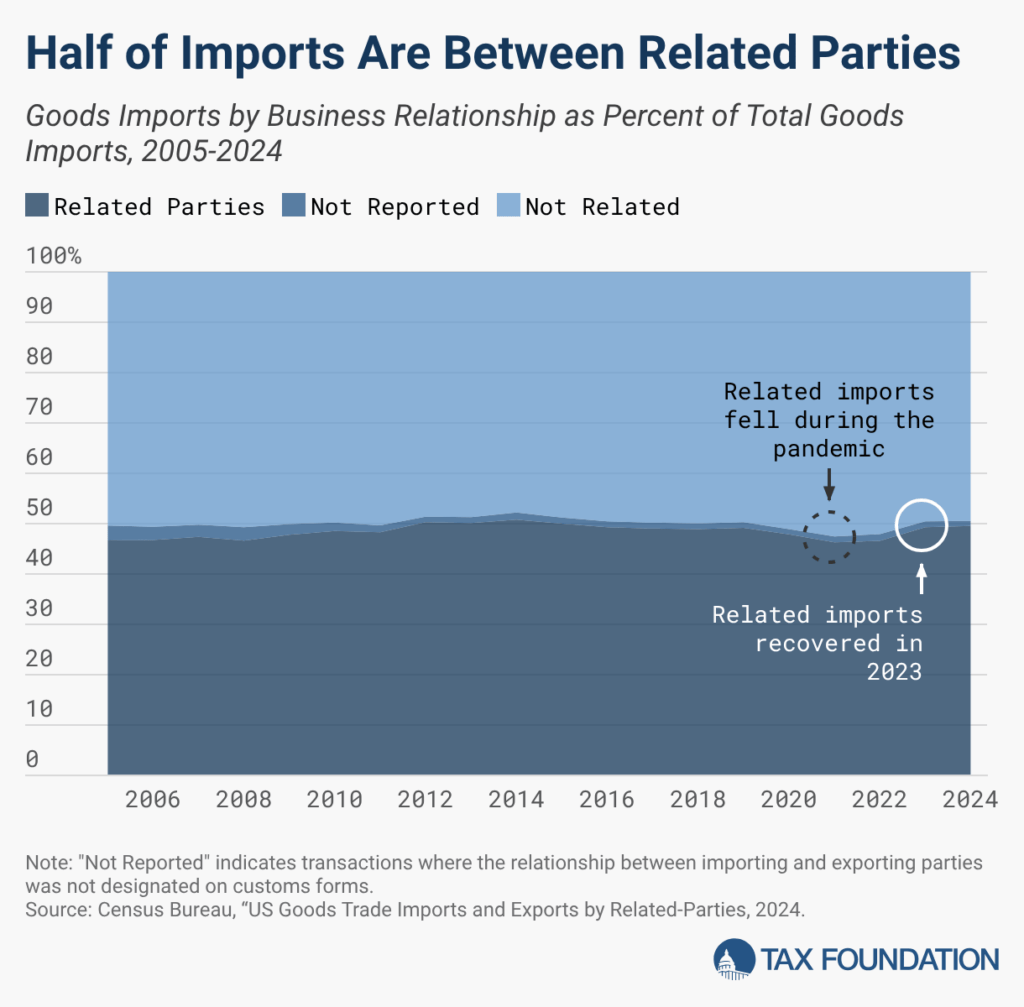
Half of all U.S. imports are transactions between affiliates of the same multinational firm, meaning that tariffs often act as a tax on domestic production networks rather than a levy on foreign exporters.
Key findings
- Related‑party imports: Census Bureau data show that 49.5 % of U.S. goods imports in 2024 were from related parties, a share that has hovered between 46 % and 51 % since 2005.
- Tariff exposure: About 45.6 % of the current tariff base consists of these related‑party imports. In some sectors the share exceeds 80 %.
- Sector breakdown
| Sector | Share of imports that are related‑party | Share of those imports subject to current tariffs |
|---|---|---|
| Autos | 96.8 % | 97.1 % |
| Pharmaceuticals | 85.5 % | 84.5 % |
| Metals | 34.0 % | 34.0 % |
| All other imports | 42.4 % | 38.0 % |
Why related‑party trade matters
Multinational firms locate production stages where labor, raw materials, or logistics are cheapest. U.S. manufacturers therefore depend on imported intermediate and capital goods from their own overseas affiliates. When tariffs are imposed on these inputs, the cost is passed through the supply chain, raising expenses for U.S. factories, slowing hiring, and prompting price increases for consumers.
Economic consequences
- Higher production costs: Tariffs on imported parts and equipment increase the cost of U.S.‑based output, forcing firms to either raise prices or accept lower profit margins.
- Investment and employment: Higher input costs can deter new plant construction, delay expansion, and reduce hiring, especially for firms that have built long‑term facilities and training programs around existing supply chains.
- Competitiveness: U.S.‑produced goods become less price‑competitive abroad when their inputs are tariff‑laden, limiting export potential.
- Policy uncertainty: Since March 2025, tariff rates have been altered more than 50 times, creating an environment where firms cannot reliably plan long‑term investments or supply‑chain adjustments.
Illustrative example
A Japanese automaker operating a U.S. assembly plant imports many components from its overseas affiliates. A tariff on those components raises the plant’s cost base, potentially prompting the company to shift production elsewhere, which would reduce U.S. jobs and investment despite the parent company being foreign‑owned.
Implications for tariff incidence analysis
Traditional views that tariffs primarily burden foreign exporters overlook the fact that nearly half of the tariff base originates from intra‑firm trade. Because the cost of related‑party imports is ultimately absorbed by U.S. production, the incidence of tariffs falls heavily on domestic businesses, workers, and consumers.
Methodology note
The related‑party share estimates combine the Census Bureau’s 2024 related‑party trade data (reported at the 6‑digit NAICS level) with tariff applicability mapped through HTS‑US to NAICS concordances. While NAICS aggregation introduces some imprecision relative to exact tariff lines, the proportional effect on related versus total imports remains consistent. The figures represent the best available approximation given the data resolution.
Source article: taxfoundation.org


