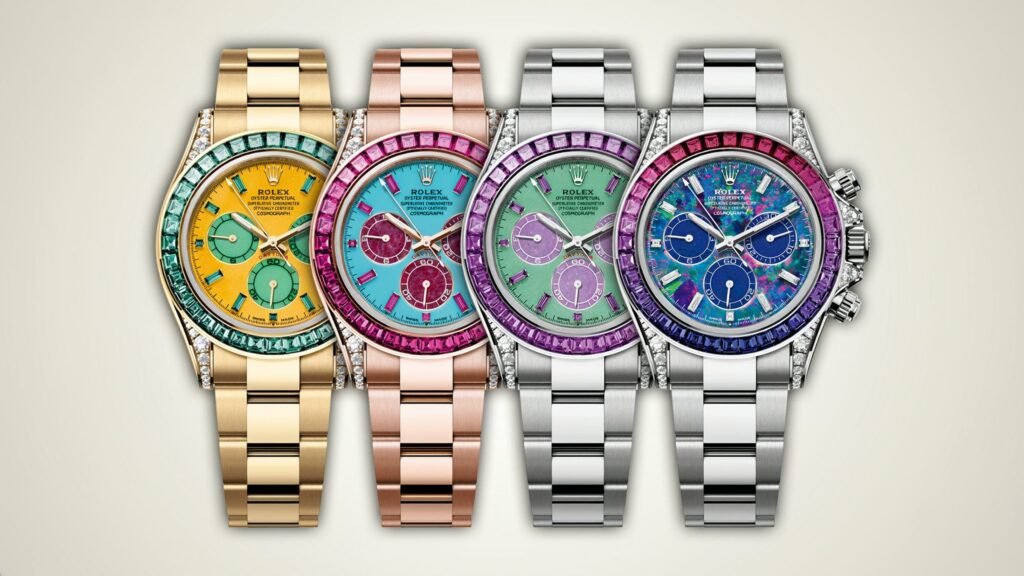
In September 2026 Phillips auctioned four one‑off Rolex Cosmograph Daytona “Four Seasons” pieces, raising a total of USD 49.4 million (≈ GBP 37.3 million) for charity. The sale marked the first time Rolex created watches expressly for public auction, highlighting the market’s appetite for rarity and storytelling in luxury timepieces.
The Four Watches
| Season | Metal | Dial & Bezel | Sale Price (USD) |
|---|---|---|---|
| Summer | 18 k Everose gold | Turquoise and ruby counters, pink sapphire bezel | 13.6 m |
| Autumn | 18 k yellow gold | Mookaite and green tourmaline bezel | 13.5 m |
| Winter | 950 pt platinum | Blue opal, lapis lazuli, sapphire bezel | 13.2 m |
| Spring | 18 k white gold | Chrysoprase and purple sapphire bezel | 9.0 m |
All four pieces share a hard‑stone dial, a gem‑set bezel, 54 diamonds on the lugs and crown guards, and Rolex’s calibre 4131 movement. Proceeds were split between the Federer Foundation (early‑childhood education in Southern Africa and Switzerland) and Re:wild (conservation, co‑founded by Leonardo DiCaprio).
Putting the Numbers in Context
- The most expensive Rolex ever sold remains Paul Newman’s Daytona at USD 17.75 million (Phillips New York, 2017).
- Phillips’ “Rainbow” Daytona (Nov 2024) fetched ≈ USD 6.3 million, well below the Four Seasons results.
- The Four Seasons watches had no prior ownership history; yet three sold for over USD 13 million each, more than double the Rainbow price.
These figures reflect the premium placed on uniqueness, craftsmanship, and the narrative of the sale, rather than a baseline market uplift for all Daytonas.
What This Means for Collectors
- Not a general price signal – The auction was a one‑off charity event with motivated bidders; typical secondary‑market sales remain far lower.
- Rarity drives value – Collectors are increasingly allocating capital to pieces with distinctive provenance or cultural significance, rather than to standard production models.
- Brand participation matters – Rolex’s willingness to create auction‑specific pieces suggests a shift toward recognizing watches as cultural objects, though future auctions are not guaranteed.
- Provenance begins at purchase – Original boxes, papers, invoices, service records, and a clear ownership chain are essential for strong resale potential.
Holding a Watch Collection Properly
- Ownership structure – Consider whether personal ownership, a holding company, or a family foundation best protects continuity and privacy, especially when watches are part of a broader asset portfolio.
- Succession planning – Ensure wills explicitly reference the collection. In jurisdictions such as the UAE, a registered will can provide certainty for non‑Muslim expatriates, while cross‑border assets may require coordinated planning.
- Documentation – Maintain a single, up‑to‑date inventory with serial numbers, valuations, and location of papers to facilitate verification by heirs or executors.
- Insurance and valuation – Schedule high‑value pieces on a dedicated policy and keep valuations current; an outdated purchase‑price valuation can lead to under‑insurance.
- Compliance – Large watch and jewellery purchases in the UAE trigger anti‑money‑laundering checks (identity verification, source‑of‑funds). Organized documentation simplifies these procedures.
- Cross‑border movement – Transferring watches between the UAE, UK, Europe, or other regions may incur customs duties and import VAT; advance planning can avoid unexpected costs.
This article provides general information and does not constitute investment, legal, or tax advice. Auction results, especially from charity sales, are not a reliable guide to the value of other watches, and collector assets can both rise and fall in value.
Source article: knightsbridge.ae


