Poland’s tax system forces many sole‑proprietors and partners to operate just below a series of sharp thresholds, creating “tax cliffs” that raise the entire tax base once crossed. Administrative data show a clear clustering of firms below these lines, indicating that the thresholds shape business behavior and impose hidden economic costs.
Tax regimes for individual business owners
- Progressive personal income tax (PIT) – 0 % on the first PLN 30 000, 12 % up to PLN 120 000, and 32 % above that. Joint filing and a wide range of deductions are available.
- Flat PIT – a flat 19 % rate with no tax‑free allowance and fewer reliefs; it prohibits providing services to a current or former employer.
- Turnover‑based tax – a levy on gross revenue (no cost deductions) ranging from 2 % to 17 % depending on activity, limited to certain sectors and capped at EUR 2 million in revenue.
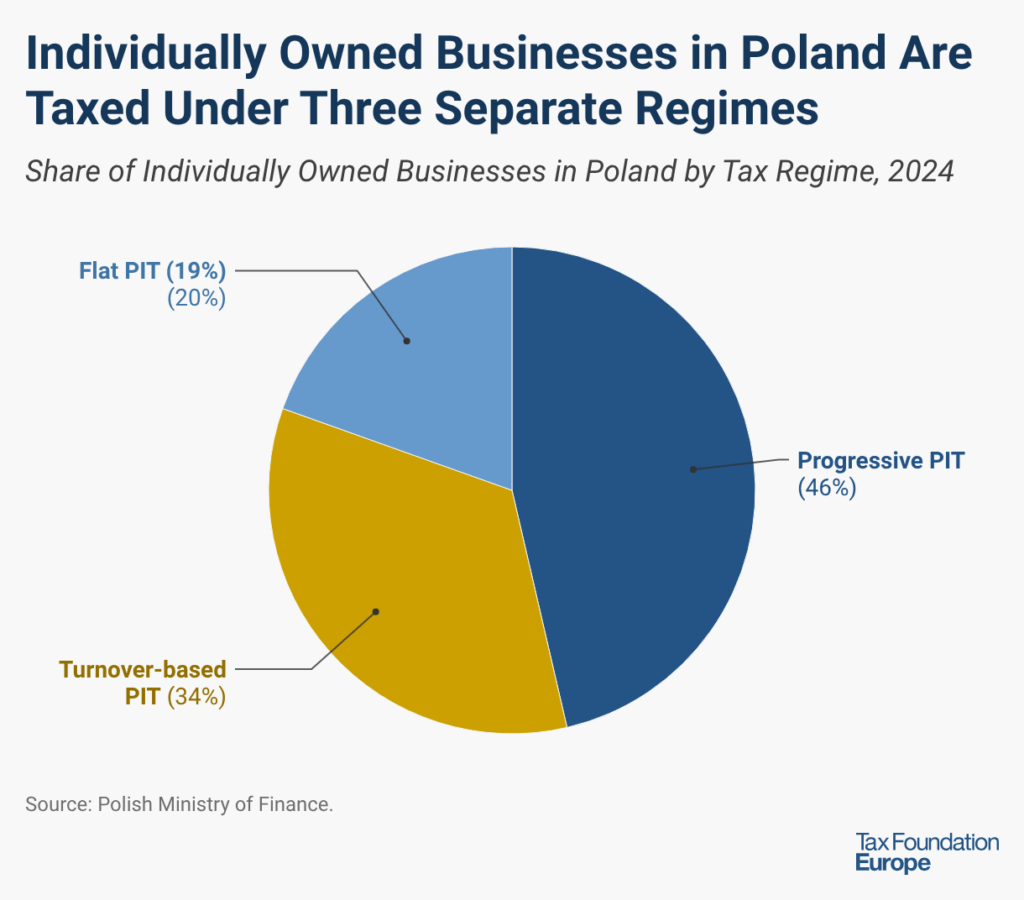
Among the 2.67 million enterprises taxed at the individual level, 46 % use the progressive scale, about one‑third the turnover‑based regime, and the remaining 20 % the flat PIT. Roughly 25 % report annual revenue below PLN 60 000 (≈ EUR 14 000) and 50 % below PLN 160 000 (≈ EUR 37 200), placing the vast majority well under the micro‑enterprise revenue cap of EUR 2 million.
Key tax cliffs
| Threshold | Basis | Effect when crossed |
|---|---|---|
| VAT registration | Revenue | Mandatory registration and 23 % VAT (reduced rates 8 %/5 %) once revenue exceeds PLN 200 000 (2025) → PLN 240 000 (2026). Below the limit firms are exempt from charging VAT and cannot reclaim input VAT. |
| Health contribution (turnover regime) | Revenue | Fixed annual contribution jumps by ≈ PLN 4 000 at PLN 60 000 and by ≈ PLN 8 000 at PLN 300 000, applied to the whole revenue rather than the marginal amount. |
| Mały ZUS Plus (social security) | Prior‑year revenue | Reduced monthly SSC (PLN 450‑1 780) for firms with revenue ≤ PLN 120 000. Above that the standard monthly contribution of PLN 1 780 applies, a jump of up to 290 % for the lowest‑income firms. |
| PIT rate change (progressive regime) | Income | Rate rises from 12 % to 32 % on income above PLN 120 000 (kink, not a notch). |
All but the PIT rate change are notches: crossing the line raises the charge on the entire base, creating a strong incentive to stay just below.
Evidence of bunching
Using 2024 Ministry of Finance data on individual owners’ annual revenue:
- A pronounced spike appears just under the VAT threshold (PLN 200 000) across all three tax regimes, indicating firms deliberately limit reported revenue to avoid VAT registration.
- A second spike occurs at the PLN 300 000 health‑contribution step in the turnover‑based regime, where the fixed charge rises by nearly 80 %.
- Around PLN 120 000, firms in the progressive and flat regimes cluster due to the combined effect of the Mały ZUS Plus ceiling (revenue‑based) and the PIT 12 %→32 % kink (income‑based). The kink produces a softer, more diffuse concentration than the notches.
These patterns demonstrate that the thresholds materially influence reporting decisions.
Economic and fiscal costs of the cliffs
-
Economic distortion – To remain below a notch, owners may:
- Reduce real output or postpone growth.
- Restructure accounts, split operations into multiple entities, or under‑report sales.
- Allocate managerial time to tax planning rather than production.
-
Fiscal impact – The same avoidance lowers the tax base, reducing revenue from income tax, health/social contributions, and VAT.
Research from other jurisdictions shows that such behavior can shift activity into the informal sector and depress productivity, especially where tax administration is weak.
Policy recommendations
- Smooth health and social contribution schedules – Replace stepwise charges with a continuous rate or a single flat contribution to eliminate notches that have no administrative benefit.
- Lower the VAT registration threshold – Poland’s current exemption (PLN 200 000/240 000) is the eighth highest among 32 EU countries and about two‑thirds above the European average. Reducing it to the EU or OECD average would diminish the incentive to under‑report revenue while still preserving a modest exemption for the smallest firms.
- Simplify the VAT base – Rather than raising the threshold, streamline VAT by reducing the number of reduced rates and exemptions, which would cut compliance costs without encouraging revenue suppression.
- Align thresholds across bases – Consider harmonizing revenue‑based and income‑based limits to reduce complexity and the need for firms to switch regimes for tax optimisation.
By removing the sharpest notches and adjusting the VAT exemption level, Poland could reduce the economic inefficiencies caused by “bunching” while maintaining a manageable compliance burden for genuine micro‑enterprises.
Source article: taxfoundation.org





