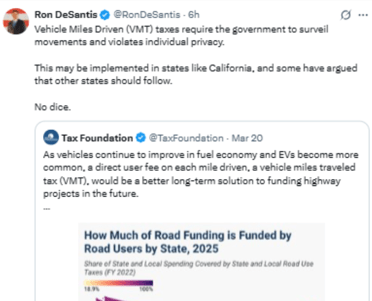
Vehicle‑miles‑traveled (VMT) taxes charge drivers a fee for each mile driven on public roads, offering a potential alternative to the declining gas tax. While the concept promises a more efficient, neutral, and stable user fee, privacy concerns have stalled adoption.
Why a VMT tax is considered superior to the gas tax
- Efficiency – A single per‑mile charge directly links road use to funding, eliminating the patchwork of excise taxes, sales taxes, and fees that currently finance highways.
- Neutrality – The charge can be adjusted for vehicle weight, avoiding favoritism toward electric or gasoline‑powered vehicles and preventing disparate burdens on specific driving activities (e.g., retail delivery or rental cars).
- Transparency – Setting a clear price per mile makes the cost of road use visible to drivers, unlike the current system where the burden is hidden across multiple taxes.
- Stability – A mileage‑based fee does not require periodic adjustments for fuel‑efficiency gains or the rise of electric vehicles, making it more future‑proof.
Privacy objections and the existing surveillance landscape
Drivers’ privacy worries stem from several ongoing practices:
- Automated license‑plate readers (ALPRs) – Nearly 100,000 ALPR cameras have been documented nationwide; the U.S. Border Patrol already uses them for AI‑driven predictive policing. Florida alone hosts more than 5,000 ALPR units, the fifth‑highest density per road mile in the country.
- Vehicle “kill‑switch” provision – The 2021 Infrastructure Investment and Jobs Act mandates that new vehicles incorporate a system capable of monitoring driver performance and disabling the vehicle if impairment is detected. Implementation details and timelines remain unclear.
- Insurance‑based monitoring – Millions of motorists voluntarily enroll in telematics programs that record detailed driving behavior, demonstrating that granular location data can be collected by private third parties.
These examples illustrate that extensive driver tracking already exists, making additional government‑run monitoring appear unnecessary.
Designing a privacy‑respecting VMT tax
A VMT tax does not require continuous location tracking. The only data needed is the total number of miles driven on public roads, which can be reported through several privacy‑conscious mechanisms:
- Annual odometer submissions – Drivers provide a yearly odometer reading, optionally accompanied by a photograph for verification. Washington’s pilot program confirmed the viability of this method, allowing exemptions for non‑taxable miles (e.g., private roads) with supporting documentation.
- Third‑party aggregation – Commercial account managers (CAMs) can collect detailed trip data from in‑vehicle devices or smartphone apps, aggregate the mileage, and transmit only the total to the taxing authority. California’s pilot projects used multiple CAMs and location‑tracking tools, alongside odometer reporting, to demonstrate feasibility.
Both approaches keep granular location data out of government hands, reducing surveillance concerns while still delivering accurate mileage totals for taxation.
Policy implications
- Legal defensibility – A VMT tax that relies solely on aggregated mileage, without government‑run tracking, is more likely to withstand constitutional challenges.
- Public acceptance – Demonstrating a clear separation between data collection (handled by private entities) and tax assessment can build the consent needed for implementation.
- Funding reliability – By linking revenue directly to road usage, a VMT tax can provide a stable financing stream for state and federal transportation programs, addressing the shortfalls in the Highway Trust Fund and state road budgets.
In summary, a well‑designed VMT tax can replace the fragmented gas‑tax system without compromising driver privacy, provided that reporting mechanisms rely on aggregated mileage data rather than continuous governmental surveillance.
Source article: taxfoundation.org





