Social Security’s projected insolvency by 2032 and the United States’ public debt exceeding 100 % of GDP have pushed lawmakers to consider tax reforms that could generate the revenue needed to keep the program solvent. Two primary options focus on the payroll‑tax system: (1) raising the taxable earnings cap and (2) expanding the payroll‑tax base to include employer‑sponsored health insurance (ESI).
Raising the Payroll‑Tax Cap (Option 45)
- Current cap: $184,500 of earnings is subject to the 12.4 % employee payroll tax (and a matching employer portion).
- Proposal: Keep the $184,500 cap but add a second payroll‑tax layer on earnings above $400,000, creating a “donut hole” between $184,500 and $400,000 that would remain untaxed. The $400,000 threshold would not be indexed for inflation, so the hole would close around 2050, effectively uncapping the tax.
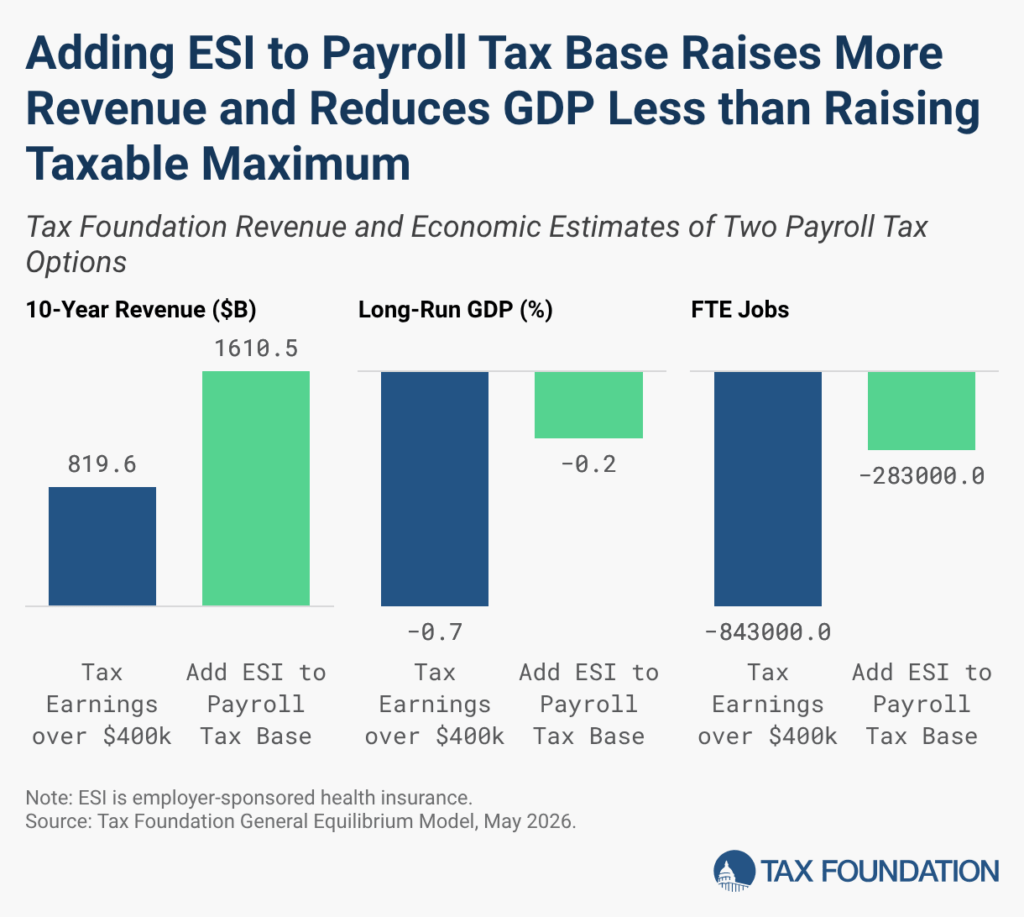
- Revenue impact: $819.6 billion over ten years (dynamic estimate).
- Economic impact: Long‑run GDP would fall by 0.7 % and full‑time equivalent employment would decline by about 843,000 jobs.
Adding Employer‑Sponsored Health Insurance to the Payroll‑Tax Base (Option 46)
- Mechanism: Eliminate the current exclusion that treats the value of employer‑provided health insurance as non‑taxable for payroll‑tax purposes.
- Revenue impact: $1.6 trillion over ten years (dynamic estimate), roughly double the revenue of the cap‑raising option.
- Economic impact: Long‑run GDP would fall by only 0.2 % and employment would decline by about 283,000 full‑time equivalent jobs.
Distributional Effects
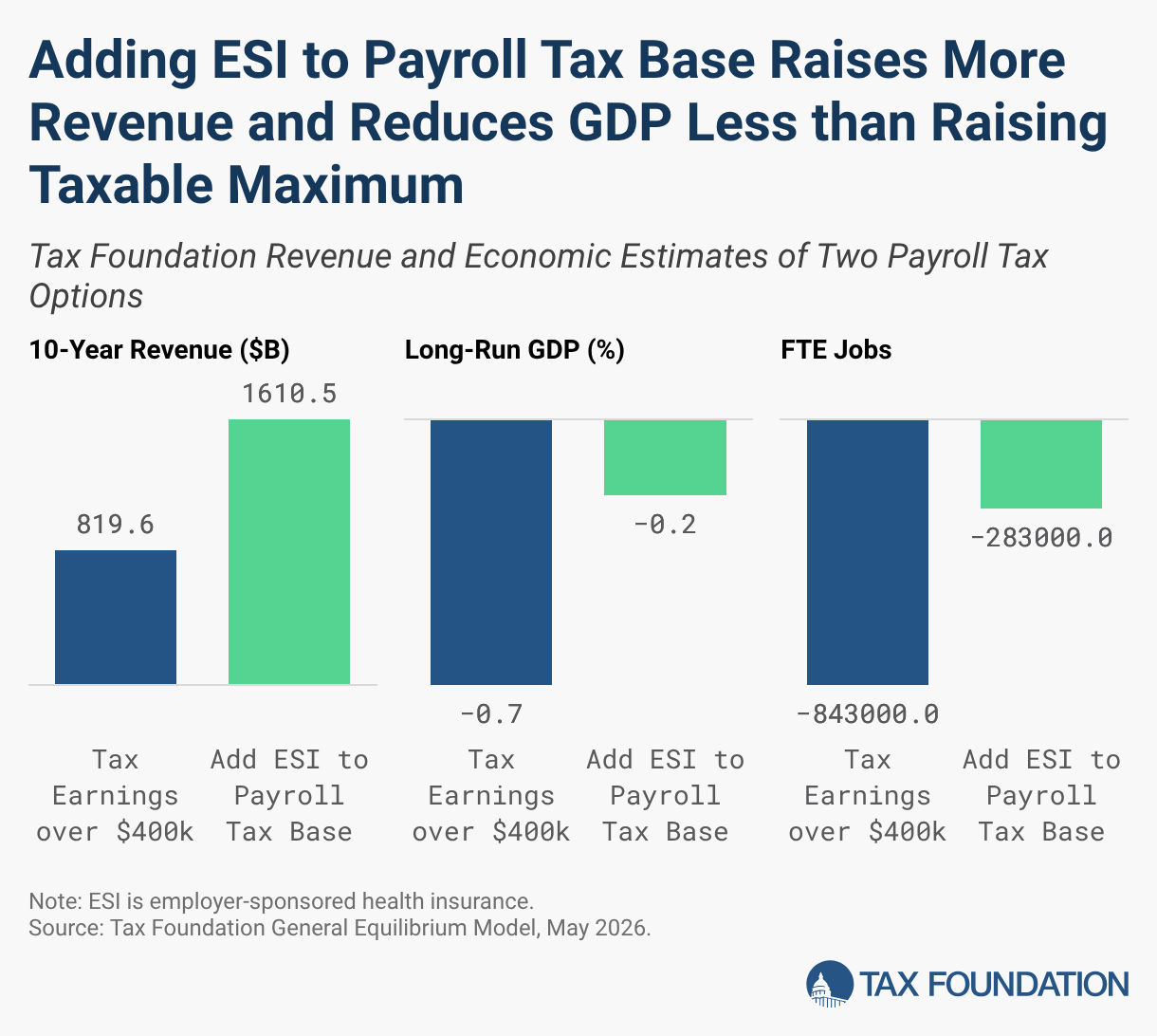
- Option 46 (ESI inclusion): Because the payroll‑tax cap remains, the highest earners see little change. The burden falls most heavily on middle‑income taxpayers, who are more likely to receive substantial employer health benefits. The bottom quintile experiences the smallest increase.
- Option 45 (donut‑hole cap): The additional tax on earnings above $400,000 primarily reduces after‑tax income for high‑income workers.
Overall, Social Security remains progressive on a lifetime basis—benefits replace a larger share of pre‑retirement earnings for low‑income workers. Including ESI in the payroll base would slightly weaken the link between taxes paid and benefits received because ESI is not counted in the benefit formula, though the effect is modest compared with uncapping the tax.
Broader Base, Lower Rates
Untaxed fringe benefits extend beyond health insurance. The Tax Foundation estimates additional dynamic revenue over the budget window from further base‑broadening:
| Fringe‑benefit extension | Estimated revenue (10 yr) |
|---|---|
| Payroll tax on other benefits (e.g., life insurance, commuter benefits) | $235.3 billion |
| Eliminate income‑tax exclusion for health insurance | $2.4 trillion |
| Extend income tax to other fringe benefits | $396.8 billion |
Collectively, these options could raise substantial revenue without raising statutory tax rates. By broadening the base rather than increasing rates, policymakers can meet funding needs while preserving economic efficiency and improving tax‑code neutrality.
Source article: taxfoundation.org





