Belgium’s May 2026 proposal to adapt corporate income tax to the digital economy would create a Digital Permanent Establishment (DPE), allocate taxable revenue according to Belgian users and digital participation, impose deemed profit margins, and introduce a digital withholding tax. Although structured as an income tax reform, its reliance on user-based revenue allocation and presumed profitability gives it many of the economic characteristics of a digital services tax (DST).
How the proposed tax would work
The proposal targets digital businesses that can generate revenue in Belgium without a physical presence, including social media platforms, e-commerce marketplaces, cloud providers, online advertising services, connected-device sellers, and other digital platforms.
A foreign company would be deemed to have a DPE in Belgium if it exceeded any of the following thresholds during a tax year:
- 60,000 users
- 3 million digital connections
- 2,400 digitally concluded or performed contracts
Instead of determining the company’s actual Belgian profit under ordinary corporate tax rules, the proposal would assign presumed profit margins to different activities:
- 10 percent for standardized paid digital services
- 15 percent for free digital services
- 25 percent for goods sold through digital activities and internet-connected devices
- 25 percent for platforms, marketplaces, and personalized services
At Belgium’s 25 percent corporate income tax rate, these deemed margins would produce effective taxes equal to:
- 2.5 percent of revenue where the presumed margin is 10 percent
- 3.75 percent of revenue where the presumed margin is 15 percent
- 6.25 percent of revenue where the presumed margin is 25 percent
This structure taxes revenue indirectly through deemed profits rather than taxing each company’s actual net income.
Low-margin businesses could face very high effective rates
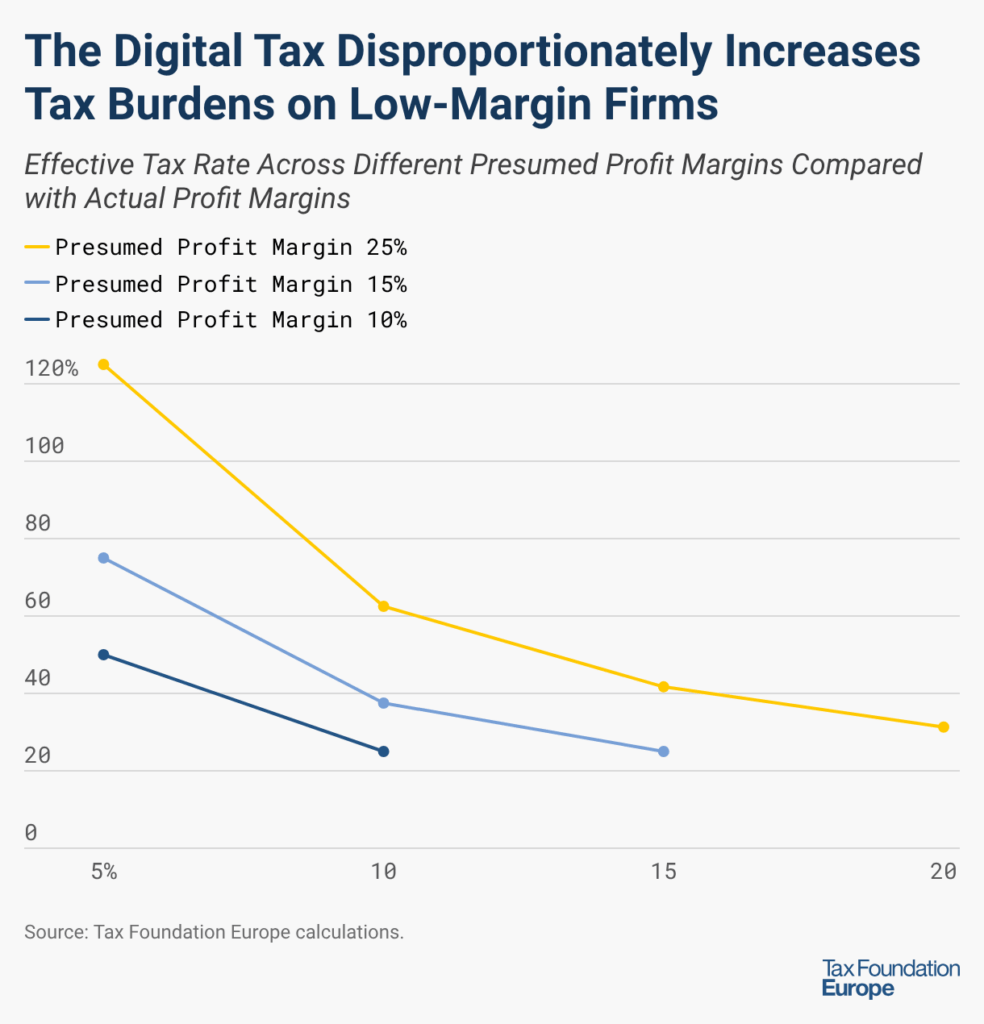
The burden would be particularly severe for businesses whose actual margins are lower than the statutory assumptions. Marketplace platforms, for example, commonly operate with margins below 15 percent.
A company earning an actual profit margin of 5 percent but assigned a deemed margin of 25 percent could face an effective tax rate of as much as 125 percent of its real profit. More generally, the system could impose effective rates above 40 percent on low-margin businesses.
Companies could challenge the presumptions by demonstrating that their Belgian-attributable revenue or profit is lower, but doing so would create additional compliance and administrative costs.
Tax pyramiding and incentives for vertical integration
Digital transactions often involve several specialized businesses, such as search engines, advertising networks, marketplaces, analytics services, social media platforms, booking intermediaries, and payment processors.
The proposed tax could apply at multiple stages of the same commercial chain. Unlike value-added tax, it would not provide a credit mechanism to prevent repeated taxation. A single final transaction could therefore generate several separate taxable revenue allocations.
This tax pyramiding would penalize specialization because every outsourced service or intermediary could add another layer of tax. It could encourage companies to bring services in-house, discourage outsourcing and innovation, and produce different effective tax burdens depending on the structure and length of a company’s supply chain.
A digital establishment does not resolve profit allocation
Traditional permanent-establishment rules under the OECD Model Tax Convention generally require a fixed place of business or a dependent agent acting for the enterprise.
Creating a DPE would establish a Belgian taxing connection without physical presence, but it would not determine how much genuine business profit belongs in Belgium. Under the arm’s-length principle, little or no profit may be attributable to a country where the company has no significant functions, assets, or risks.
The proposal attempts to overcome this problem through formula-based revenue allocation and deemed margins. This replaces actual profit attribution with a statutory assumption rather than resolving the underlying question of where the profit was created.
Debate also remains over whether user activity, data generation, engagement, and network effects constitute locally created value. Measuring that contribution is difficult, especially when services are free. Network effects are also present outside the digital sector in telecommunications, shopping malls, payment networks, medical research, and pharmaceuticals, raising questions about why digital companies should be subject to separate rules.
Double-taxation risks
Belgium could recognize a DPE when another treaty country does not, or another jurisdiction could reject Belgium’s allocation method while continuing to tax the same income. This could leave more than 100 percent of a company’s income exposed to tax across different jurisdictions.
The risk is greater because the Belgian liability would be calculated from revenue and presumed margins rather than actual profit.
Article 24(3) of the OECD Model Tax Convention generally requires permanent establishments to receive tax treatment comparable to resident companies. Under the proposal, however, DPEs would be taxed using deemed profitability and attributed revenue, while resident companies ordinarily pay corporate tax on actual taxable profits.
Overlapping claims could lead to mutual-agreement proceedings, litigation, uncertainty, and cases in which double taxation remains unresolved.
The proposal itself acknowledges that combined taxes imposed by two jurisdictions could reduce a company’s profit margin enough to force price increases. It treats this as an intended response to prices considered artificially low because of tax optimization. The effect could be greater if more than two jurisdictions taxed the same revenue or deemed profit.
Digital withholding tax
Where digital corporate income tax is due for one fiscal year, the proposal would impose a digital withholding tax in the following year equal to 80 percent of that liability.
The withholding tax would generally be non-refundable unless the amount paid exceeded 80 percent of the company’s final digital corporate income tax liability. It would therefore operate as both a minimum-tax mechanism and an additional gross-basis charge.
Loss-making businesses could face a cash-flow burden even if they ultimately owed little or no digital corporate income tax.
Questions over tax-treaty reinterpretation
The proposal relies substantially on reinterpreting existing international tax treaties to cover digital activity without physical presence.
Article 31 of the Vienna Convention on the Law of Treaties requires treaty terms to be interpreted according to their ordinary meaning, context, object, and purpose. Article 32 permits supplementary interpretive material, including preparatory work and the circumstances in which the treaty was concluded, when Article 31 leaves the meaning ambiguous or produces a manifestly absurd or unreasonable result.
The legal concern is that Article 32 could be used not to identify the original intentions of treaty negotiators but to support an expanded meaning that Article 31 would not otherwise sustain.
Courts have used both static and evolutionary approaches to treaty interpretation, with no clear rule favoring either method. Dynamic interpretation may adapt an agreement to new circumstances, but it can also depart from the meaning understood by the negotiating governments and national legislatures when they approved the treaty. It may also undermine the expectations of the other contracting state.
The continuing negotiations at the OECD, EU, and UN reflect broad recognition that traditional permanent-establishment rules do not adequately cover businesses operating without physical presence. Those negotiations also weaken the argument that existing treaty language can simply be reinterpreted to create a digital establishment unilaterally.
Trade and retaliation risks
DSTs have frequently been viewed as disproportionately targeting US technology companies. The United States has opposed such taxes, including through Section 301 investigations during President Trump’s first term. Congress also considered a retaliatory Section 899 tax, although it was removed from the One Big Beautiful Bill Act.
Because many large digital companies affected by Belgium’s proposal are headquartered in the United States, the measure could revive similar transatlantic disputes.
The United States is Belgium’s fourth-largest export market. Belgium exports approximately €31.9 billion in goods and services to the US and imports about €35.1 billion. In information and communication technology services, Belgium imports roughly €0.7 billion from the US while exporting approximately €0.34 billion.
Trade in digitally deliverable services is nearly balanced, with Belgian imports of about €3.21 billion and exports of €3.2 billion. Retaliatory measures could therefore affect a broader economic relationship extending beyond the digital companies directly taxed.
Consumers and smaller businesses may bear the cost
A revenue-based digital tax operates more like an excise tax than an ordinary corporate income tax. Companies may pass the expense to customers through higher prices or additional fees.
Apple, Amazon, and Google passed on the cost of the United Kingdom’s 2 percent DST. Google has also applied country-specific DST charges where advertisements are accessed.
The resulting burden can fall on consumers, local advertisers, marketplace sellers, and small and medium-sized businesses that depend on large platforms. Lower-income households may be disproportionately affected if prices rise because they generally spend a larger share of their income on consumption.
Research cited in the proposal’s analysis indicates that much of the cost imposed on major platforms ultimately falls on European consumers. IMF research also associates DST adoption with lower imports of digital services.
Extensive reporting requirements
Affected companies would have to track and report:
- Global and Belgian revenue
- User numbers and locations
- Digital connection counts
- Contracts concluded or performed digitally
- Country-level allocation data
- Global metrics used in allocation calculations
- GDP-weighting adjustments
Businesses challenging the standard allocation method would also have to produce evidence supporting an alternative calculation.
Identifying users, determining their location, attributing revenue, and continuously verifying operational data across jurisdictions would create substantial costs and possible disputes over accuracy. The proposal’s combination of user thresholds, connection counts, global allocation formulas, and GDP adjustments could make it more complex than many existing digital tax systems.
Limited expected revenue and broader economic costs
Existing DSTs generally account for a small share of government revenue. In the most recently reported years, revenue ranged from €137 million in Austria to €1.04 billion in the United Kingdom. These taxes typically produced less than 0.1 percent of total government revenue.
Turkey had the highest relative result among the countries examined, at approximately 0.24 percent of government revenue. The UK collected about 0.1 percent, while Austria, France, Italy, and Spain collected approximately 0.05 to 0.07 percent.
Tax Foundation modeling of a Belgian tax comparable to the 3 percent DST proposed in April 2026 estimated:
- Annual revenue of approximately €148 million
- Revenue equal to less than 0.06 percent of Belgium’s total tax receipts
- A GDP reduction of approximately 0.056 percent, or €342 million annually
- An investment decline of approximately 0.073 percent
- A 0.03 percent reduction in wages
- A 0.03 percent reduction in employment or hours worked
- A 0.053 percent reduction in total labor compensation
Under those estimates, the €342 million reduction in economic output would be about 2.3 times the projected €148 million in annual revenue. Lower economic activity could also reduce receipts from other taxes, potentially offsetting part or all of the direct fiscal gain.
VAT as an alternative
A destination-based VAT can tax digital services where they are consumed without introducing sector-specific profit assumptions or cascading taxes. It can cover streaming, online advertising, cloud computing, software subscriptions, and marketplace services.
EU reforms already require non-EU businesses to register and remit VAT in the consumer’s member state. Revenue collected through the EU’s digital VAT measures rose from:
- €3 billion in 2015
- €4.5 billion in 2018
- €20 billion in 2022
- More than €33 billion in 2024
Applying Belgium’s standard 21 percent VAT rate to all imports from information industries was estimated to generate about $9.5 billion, or €8.15 billion, equivalent to approximately 3.3 percent of total Belgian tax revenue.
Belgium’s actionable VAT policy gap—the additional revenue considered realistically collectible by removing reduced rates and selected exemptions—was estimated at 27.6 percent in 2024. Broadening the VAT base could generate as much as €26.9 billion, equivalent to 10.76 percent of Belgium’s 2023 tax revenue.
Compared with the proposed digital tax, a broad destination-based VAT would offer a larger and more neutral tax base, avoid tax pyramiding, fit existing international consumption-tax principles, and carry less risk of trade retaliation.
Belgium’s proposal combines user-based market taxation, unilateral digital nexus rules, presumed profit margins, and a gross-basis withholding mechanism. Its principal risks include disproportionately high taxes on low-margin firms, repeated taxation through digital supply chains, double taxation, treaty disputes, administrative complexity, higher costs for Belgian consumers and businesses, and international retaliation. Its projected revenue is modest relative to both Belgium’s overall tax receipts and the estimated economic costs.
Source article: taxfoundation.org




