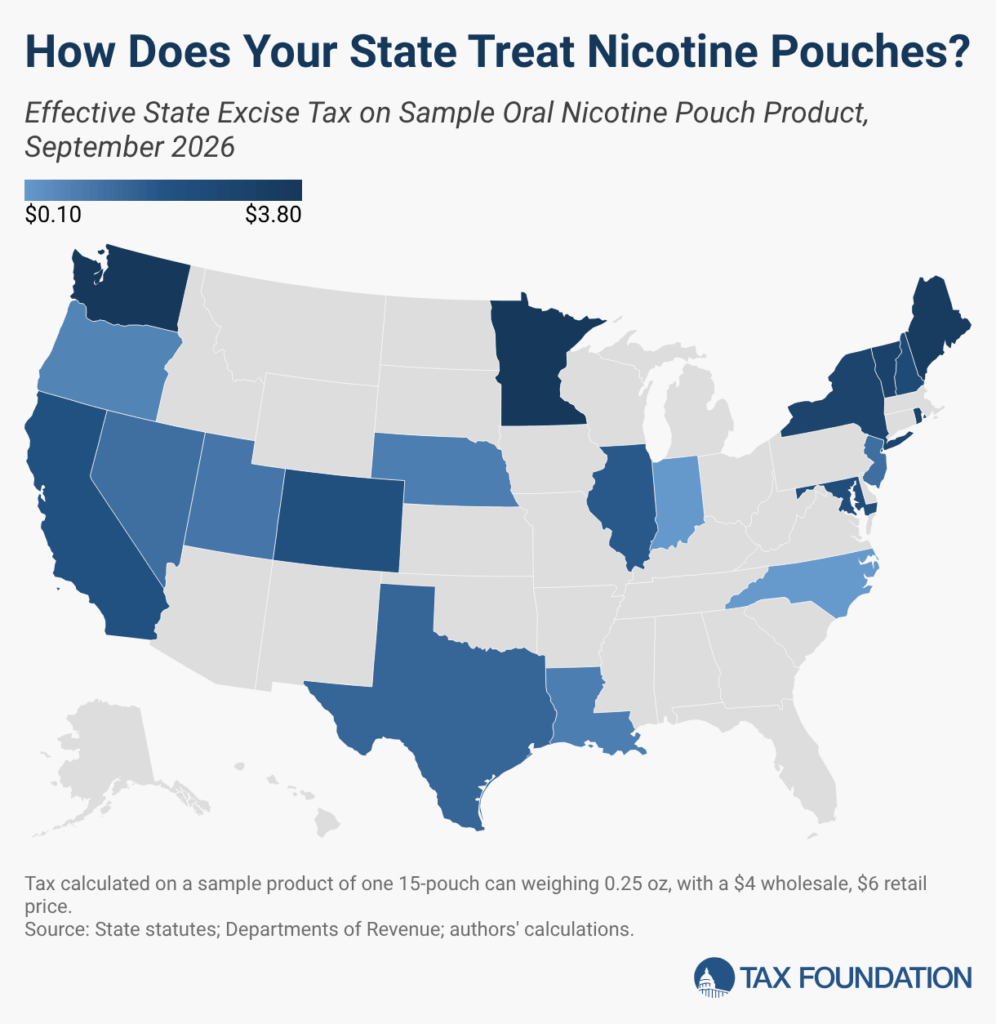
Oral nicotine pouches are gaining market share as a non‑combustible alternative to cigarettes, prompting states to decide how to tax these products. The tax approach influences both state revenue—offsetting the decline in cigarette tax collections—and public‑health outcomes, since higher taxes on less‑harmful products can slow the shift away from smoking.
Current tax landscape (as of September 2026)
- 20 states plus the District of Columbia have incorporated nicotine pouches into their tax codes.
- Most states tax pouches under a generic “Other Tobacco Products” (OTP) category, often using an ad valorem (percentage‑of‑price) structure.
- Experts argue that a per‑unit or weight‑based tax (ad quantum) better reflects the product’s lower risk profile.
Sample product tax estimates
A standard can (15 pouches) sold wholesale for $4 and retail for $6 was used to compare state taxes:
| State (high) | Tax per can | Basis |
|---|---|---|
| Minnesota, Washington | $3.80 | 95 % wholesale tax |
| Maine | $3.54 | Weight‑based tax, 1‑oz minimum |
| Rhode Island | $3.20 | 80 % wholesale tax |
| Vermont | $3.08 | Weight‑based tax, 1.2‑oz minimum |
| State (low) | Tax per can | Basis |
|---|---|---|
| North Carolina | $0.10 | $0.005 per pouch (20‑pouch can) |
| Indiana | $0.13 | $0.50 per ounce, no minimum |
| Oregon | $0.65 | Flat per‑can rate |
| Louisiana, Nebraska | $0.80 | 20 % wholesale tax |
Recent notable tax changes
| State | Change | Effective date |
|---|---|---|
| Illinois | Expanded tobacco tax to include pouches; rate tripled from 15 % to 45 % wholesale | July 1 2025 |
| Indiana | Increased tax on alternative nicotine products from $0.40 to $0.50 per ounce | July 1 2025 |
| Maine | Raised tax on smokeless tobacco (including pouches) from $2.02 to $3.54 per ounce | Jan 5 2026 |
| Nebraska | Added alternative nicotine products at existing 20 % wholesale rate | Jan 1 2026 |
| New York | Extended tobacco tax to alternative nicotine products at 20 % wholesale | Sep 1 2026 |
| North Carolina | Added $0.010 per standard can for alternative nicotine products | July 1 2025 |
| Oregon | Created a new tax of $0.65 per standard can for oral nicotine products | Jan 1 2026 |
| Rhode Island | Included nicotine pouches at existing 80 % wholesale rate | Oct 1 2025 |
| Utah | Adjusted tax from $1.83 per ounce to $1.00 per standard can | July 1 2026 |
| Washington | Expanded tobacco product tax to cover pouches at 95 % wholesale | Jan 1 2026 |
| Iowa (future) | Established $0.05 per can tax on alternative nicotine pouches | Jan 2027 (planned) |
Policy implications
- Revenue vs. harm reduction: As cigarette consumption falls, states lose a traditional tax base. Taxing nicotine pouches can recoup some revenue, but overly high rates may discourage smokers from switching to a less harmful product.
- Cross‑border arbitrage: Large tax differentials create incentives for consumers to purchase pouches in neighboring low‑tax states (e.g., Washington residents saving ~$3.15 per can by buying in Oregon or Idaho), potentially fostering illicit trade.
- Tax design recommendations:
- Apply a specific per‑unit or weight‑based tax rather than a percentage of price.
- Set rates at a fraction of cigarette excise taxes, reflecting the substantially lower health risks of nicotine pouches.
- Avoid lumping pouches with traditional OTPs such as cigars or snuff, which have higher associated harms.
Outlook
With smoking rates continuing to decline, more jurisdictions are expected to adopt taxes on nicotine pouches. A principled tax framework—balancing fiscal needs with the public‑health goal of encouraging smokers to transition to lower‑risk products—can help states capture revenue while preserving the harm‑reduction benefits of oral nicotine pouches.
Source article: taxfoundation.org




