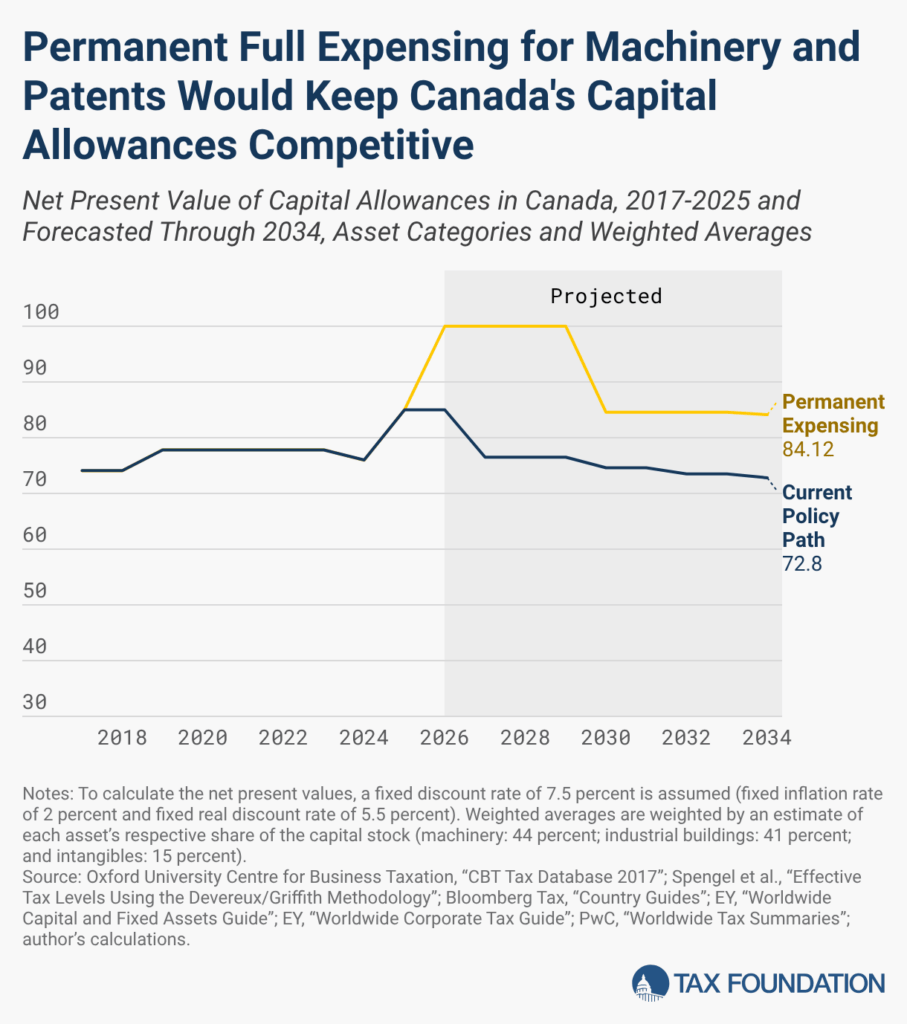
Canada’s finance ministry announced that full expensing for machinery, equipment and patent rights will become permanent, eliminating the scheduled phase‑out that was set to begin after 2029. The change is intended to give investors a stable, low‑cost capital environment and to keep Canada competitive among OECD economies.
Background to the policy
- 2018 – Canada introduced temporary “bonus depreciation” and accelerated cost‑recovery rules for equipment, machinery, clean‑energy assets, and certain intangible assets.
- 2024‑2025 – The temporary measures were reinstated and slated to run through 2029, after which they would taper off between 2030 and 2033.
- Key phase‑out schedule (if unchanged)
- Manufacturing and processing buildings: first‑year write‑off would fall from 15 % (2025) to 10 % (2034).
- Other non‑residential buildings: from 9 % to 6 % over the same period.
- Equipment and machinery: deduction would decline from 100 % (2025) to 93.5 % (2034) in net‑present‑value terms.
- Intangible assets: projected to rank second‑lowest among OECD countries by 2027, with a recovery rate of only 43 %.
- Overall, the share of capital that could be deducted would drop from 85 % (2025) to 72.8 % (2034).
A separate bill (Bill C‑31) is moving through the Senate to allow immediate expensing for manufacturing and processing buildings acquired on or after 4 Nov 2025.
The “Productivity Mega Deduction”
The permanent‑full‑expensing proposal would:
- Keep 100 % immediate deduction for machinery, equipment and patent rights.
- Expand the scope of full expensing to cover roughly two‑thirds of private‑business capital investment.
- Maintain the gradual phase‑out of temporary expensing for manufacturing/processing buildings and accelerated depreciation for other non‑residential buildings.
If enacted, the net‑present‑value of capital cost recovery across the entire capital stock would remain at 84.1 % in 2034, instead of falling to 72.8 % under the original schedule.
International competitiveness
- With permanent full expensing, Canada would rank 4th among 38 OECD countries for capital cost recovery, behind only three Baltic states that use distribution‑based corporate tax systems.
- By 2030, Canada’s overall cost‑recovery rate (≈ 84 %) would exceed the OECD average of 68.8 % and surpass the United Kingdom, the European Union (subject to its narrower R&D expensing proposal), and the United States once the U.S. industrial‑building expensing phases out (2028‑2030).
- Lithuania has already adopted permanent full expensing for machinery, equipment and most intangibles (starting 2026).
- The United States currently offers a broader regime for machinery and industrial buildings, but its building expensing is set to expire before Canada’s accelerated depreciation for non‑residential buildings, potentially making Canada’s regime more favorable in the near term.
Tax competitiveness impact
- The International Tax Competitiveness Index (ITCI) 2025 shows Canada moving from 22nd to 19th among OECD countries due to the 2025 temporary expensing measures.
- Making full expensing permanent would likely preserve the 19th position, preventing a slide back to the previous rank.
Practical implications for businesses
- Immediate cash‑flow benefit – Full expensing allows the entire cost of eligible assets to be deducted in the year they become available for use, reducing taxable income and effective tax rates.
- Investment certainty – Permanence removes the risk of future policy reversals, supporting long‑term capital planning.
- Scope limitation – The permanent provision applies only to machinery, equipment and patent rights; buildings and other non‑residential assets will continue to be subject to phased‑out accelerated depreciation schedules.
Overall, the permanent “Productivity Mega Deduction” aims to solidify Canada’s position as a competitive destination for capital‑intensive investment by ensuring a stable, high‑rate capital cost recovery regime.
Source article: taxfoundation.org




