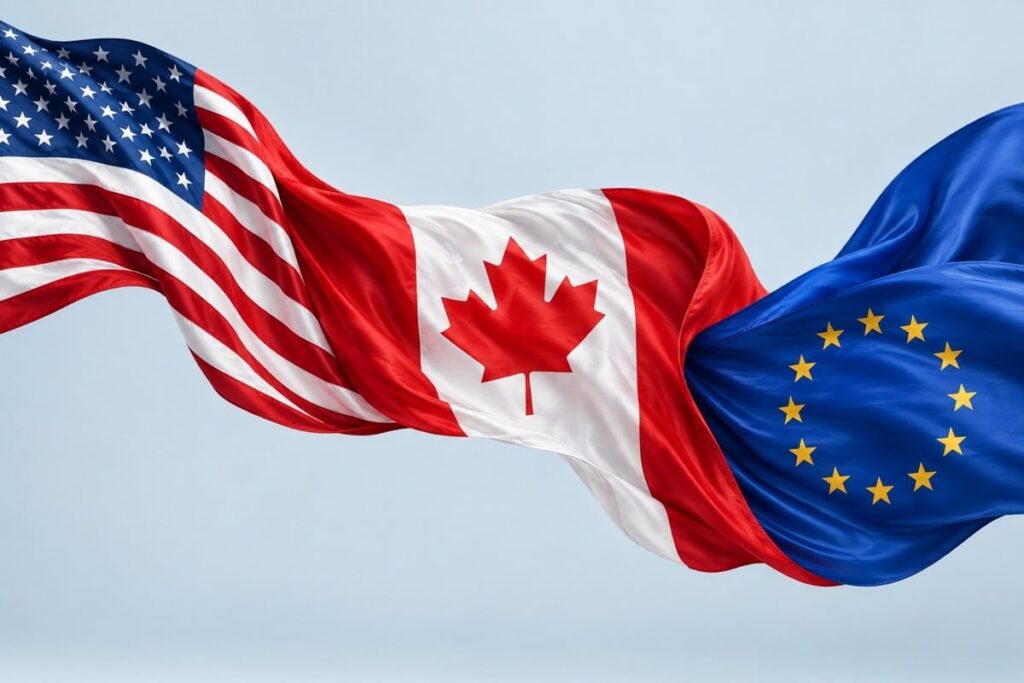
Canada is in early talks to become the European Union’s first “associate member,” a status that could deepen cooperation in energy, critical minerals, artificial intelligence and digital trade, and expand mobility for citizens of both regions.
Potential Canada‑EU associate membership
- European Commission President Ursula von der Leyen suggested the associate‑member model on 16 September 2024, following a Wall Street Journal report that Prime Minister Mark Carney was pursuing the same goal.
- Carney told the European Parliament on 17 September that Canada welcomes the ambition and highlighted the desire to “deepen people‑to‑people ties,” allowing youth to work, study and live on either side of the Atlantic.
- He also mentioned that Canadian participation in the EU’s Erasmus+ programme would give students access to top universities across Europe.
Existing youth‑mobility framework
- Canada already has bilateral youth‑mobility agreements with more than 35 countries, including over a dozen EU members.
- The International Experience Canada (IEC) programme issues open work permits for categories such as Working Holiday, Young Professionals and International Co‑op.
- Canadian citizens aged 30 (or up to 35 in some agreements) can live and work temporarily in countries like France, Germany and Belgium.
- A Canadian passport also provides visa‑free short stays throughout the Schengen Area and currently ranks higher than the U.S. passport in global mobility indexes.
Americans with Canadian ancestry
- Bill C‑3, which took effect on 15 December 2025, removed the first‑generation limit on citizenship by descent. Anyone born before that date who can trace a line of descent to a Canadian ancestor—grandparent, great‑grandparent or further—may claim Canadian citizenship.
- As Canadian citizens, these individuals gain:
- A Canadian passport with visa‑free Schengen access.
- Eligibility for Canada’s public health care and social services if they reside in Canada.
- Access to IEC youth‑mobility agreements, potentially expanding their ability to work and study in Europe if a Canada‑EU deal broadens the existing framework.
Applying for a Canadian citizenship certificate
- Identify an “anchor ancestor” – the Canadian relative through whom the claim runs.
- Gather documentation proving the ancestor’s Canadian citizenship and an unbroken line of descent for each generation.
- Submit a complete application to Immigration, Refugees and Citizenship Canada (IRCC) with identity documents, photographs meeting specifications, and proof of fee payment.
Since Bill C‑3’s enactment, demand for citizenship certificates has surged, especially from U.S. citizens. Applications filed in January 2026 from Americans outnumbered the combined total from the next nine source countries. The backlog grew from 70,400 pending decisions in May 2026 to 136,000 in September 2026, nearly doubling in four months.
Outlook
The associate‑member proposal remains at an early stage; negotiations could take months or years, and a Canada‑EU summit scheduled for late October may clarify details. For Americans who now qualify for Canadian citizenship, the immediate actionable step is to apply for proof of citizenship, positioning themselves to benefit from any future Canada‑EU agreements that expand trade, education exchanges or mobility across Europe.
Source article: www.cicnews.com



