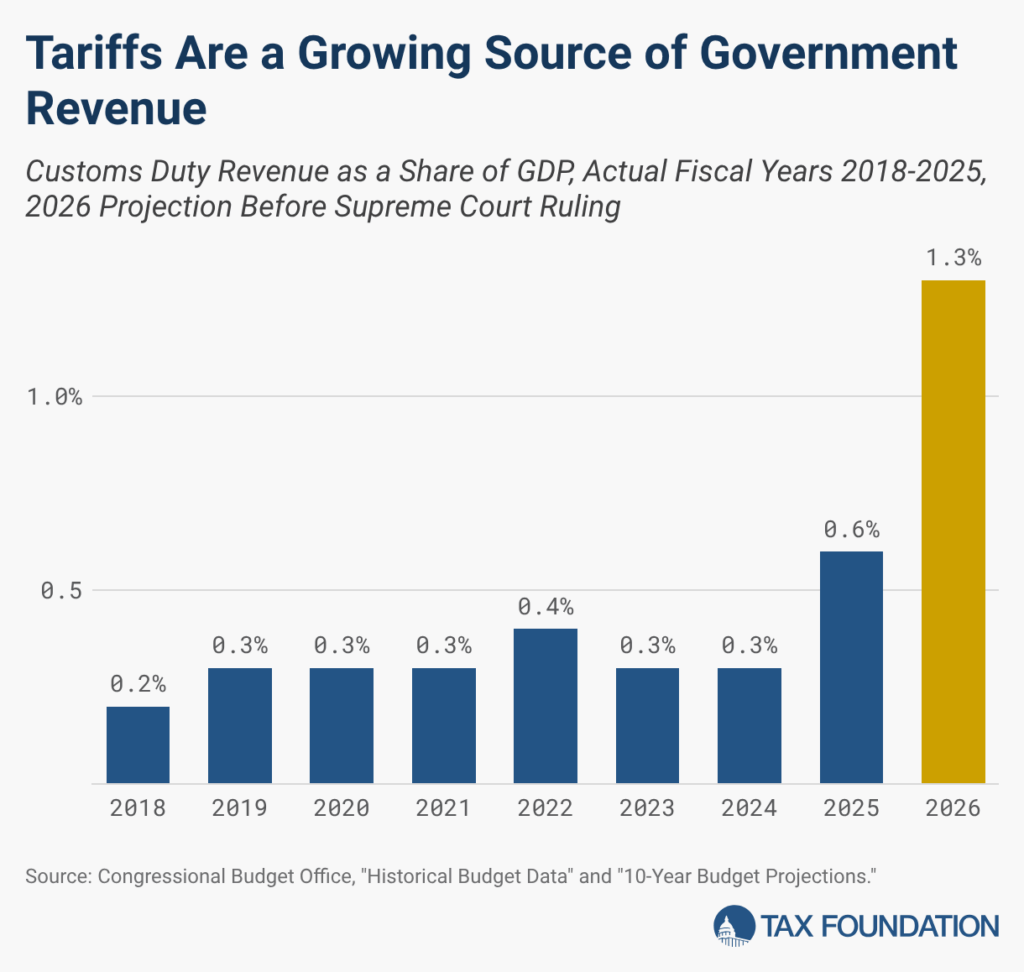
Tariffs have become a major source of federal revenue, but they also raise prices, limit the availability of goods, and create legal and economic uncertainty. Recent modeling suggests that a modest, broad‑based value‑added tax (VAT) could replace the revenue from recent tariff increases while delivering modest gains in output and reducing fiscal distortions.
Tariff revenue and fiscal outlook
- Tariff receipts have more than tripled as a share of GDP since the 2018 increases under the Trump administration.
- Many of the newer tariffs were imposed under executive authority (e.g., Sections 122, 301, 232) and were struck down by the Supreme Court in February 2026, highlighting their instability.
- Even with this revenue, the United States faces annual deficits projected to exceed $2 trillion within a few years and $3 trillion by 2036.
- Interest payments on the national debt are expected to surpass $2 trillion by 2035, outpacing defense spending and approaching the size of major programs such as Medicare.
Cost of repealing the tariffs
- Removing all new tariffs—including those added during the first Trump term—would forgo approximately $1.8 trillion in revenue for the federal government over the 2027‑2036 budget window.
- Tariff repeal would lower marginal tax rates on labor and investment, potentially increasing output and hours worked, but the revenue gap would need to be filled.
Value‑added tax as a replacement
A VAT is a consumption tax levied on the incremental value added at each production stage. It is administered through a credit‑invoice system: businesses charge VAT on sales but receive a credit for VAT paid on inputs, eliminating tax pyramiding on intermediate transactions.
Key characteristics:
- Neutral between consumption and saving – it does not penalize investment returns as income taxes do.
- Neutral with respect to trade and capital – it does not distort the cost of capital or create trade retaliation.
- Broad base – can be applied to most final consumer goods and services, with limited exemptions (e.g., groceries) to keep rates low.
- Economic burden – still reduces after‑tax returns to work, modestly shrinking labor supply.
Projected impact of a 1 % VAT
Using the Tax Foundation’s tariff and general‑equilibrium models (September 2026):
| Metric | Conventional estimate | Dynamic estimate |
|---|---|---|
| Revenue replacement | Revenue‑neutral (covers $1.8 trillion loss) | Generates $130.1 billion in additional revenue over the budget window |
| Debt‑to‑GDP (2056) | Roughly unchanged | 1.3 percentage‑point lower (from 175.9 % to 174.7 %) |
| Economic output | Increases due to lower marginal tax rates | Gains for all income groups from higher output |
| Distributional effect | Revenue‑neutral swap produces minimal shift in tax burden | Dynamic gains across income brackets |
The analysis indicates that a broad‑based 1 % VAT could fully offset the fiscal shortfall from tariff repeal, improve economic efficiency, and modestly improve the debt trajectory when dynamic effects are considered.
Policy considerations
- Replacing tariffs with a VAT would eliminate the trade‑related distortions and geopolitical retaliation associated with import taxes.
- A VAT’s administrative structure—credit‑invoice with business‑to‑business exemptions—avoids the “tax pyramiding” that can arise from sales‑tax systems.
- While the swap is revenue‑neutral on a static basis, the dynamic gains suggest a net fiscal benefit and broader economic growth.
- Distributional impacts appear limited; the reform would not substantially shift the tax burden, and all income groups would benefit from the output increase.
Conclusion: Given the fiscal pressure from large deficits, the volatility of recent tariff revenues, and the economic inefficiencies of import taxes, a modest, broad‑based VAT offers a viable, lower‑distortion alternative for raising sustainable revenue while supporting modest growth in output and capital formation.
Source article: taxfoundation.org


