The US-Mexico-Canada Agreement faces its first major review deadline on July 1, 2026. If the United States, Canada, and Mexico fail to renew or extend the agreement cleanly, the review process could move into annual negotiations, increasing uncertainty around North American trade and raising the risk of higher tariffs.
Why USMCA matters
USMCA took effect in July 2020 and modernized the former North American Free Trade Agreement. NAFTA had already reduced tariffs to zero on most goods traded among the three countries. USMCA focused more on non-tariff barriers, including digital services, e-commerce, and intellectual property.
Key USMCA provisions include:
- Free movement of data across borders
- No discriminatory treatment of digital products
- Restrictions on forced localization of computing facilities
- Tighter rules-of-origin requirements for automobiles
- Reduced use of investor-state dispute settlement
- Requirements for Mexico to strengthen labor standards and collective bargaining arrangements
The United States International Trade Commission estimated that USMCA would increase long-run US GDP by 0.35% and add 176,000 US jobs.
Not every provision was expected to help growth. The same USITC report estimated that stricter rules of origin would reduce economic growth by increasing the cost of auto parts and making domestic manufacturing more expensive.
Canada and Mexico remain central US trading partners. Together, they accounted for more than $1.8 trillion in goods and services trade in 2024, with major links to manufacturing, agriculture, and energy.
What happens at the 2026 review
USMCA is scheduled to expire after 16 years unless the three countries confirm through a joint review process that they want to continue it. The first review occurs six years after the agreement took effect, with a July 1, 2026 deadline.
If the countries do not agree to a clean extension by that date, the agreement moves into annual reviews. If no consensus is reached, USMCA would expire in 2036.
The Trump administration’s stated concerns include:
- The US trade deficit with Canada and Mexico
- Chinese exports allegedly routing through Mexico
- Limited access to Canada’s dairy market for US exporters
Mexico wants to relax some rules-of-origin requirements, while the United States wants to tighten them further.
A clean extension by July 1 is described as unlikely. More likely outcomes include annual reviews, a move toward bilateral deals, or new concessions.
Tariffs and USMCA exemptions
The USMCA review is happening against a backdrop of tariff uncertainty.
In February 2025, President Trump used the International Emergency Economic Powers Act to announce 25% tariffs on most imports from Canada and Mexico. The tariffs took effect in March 2025, but a 30-day exemption was announced for USMCA-covered imports and later extended indefinitely.
In July 2025, the president announced plans to raise tariffs on Canadian imports to 35% and Mexican imports to 30% by August. The Canadian increase took effect, while the Mexican increase was delayed 90 days and later postponed indefinitely.
A Supreme Court ruling in February 2026 struck down the IEEPA tariffs. The administration then replaced them with a 10% Section 122 tariff that also exempts USMCA-compliant goods.
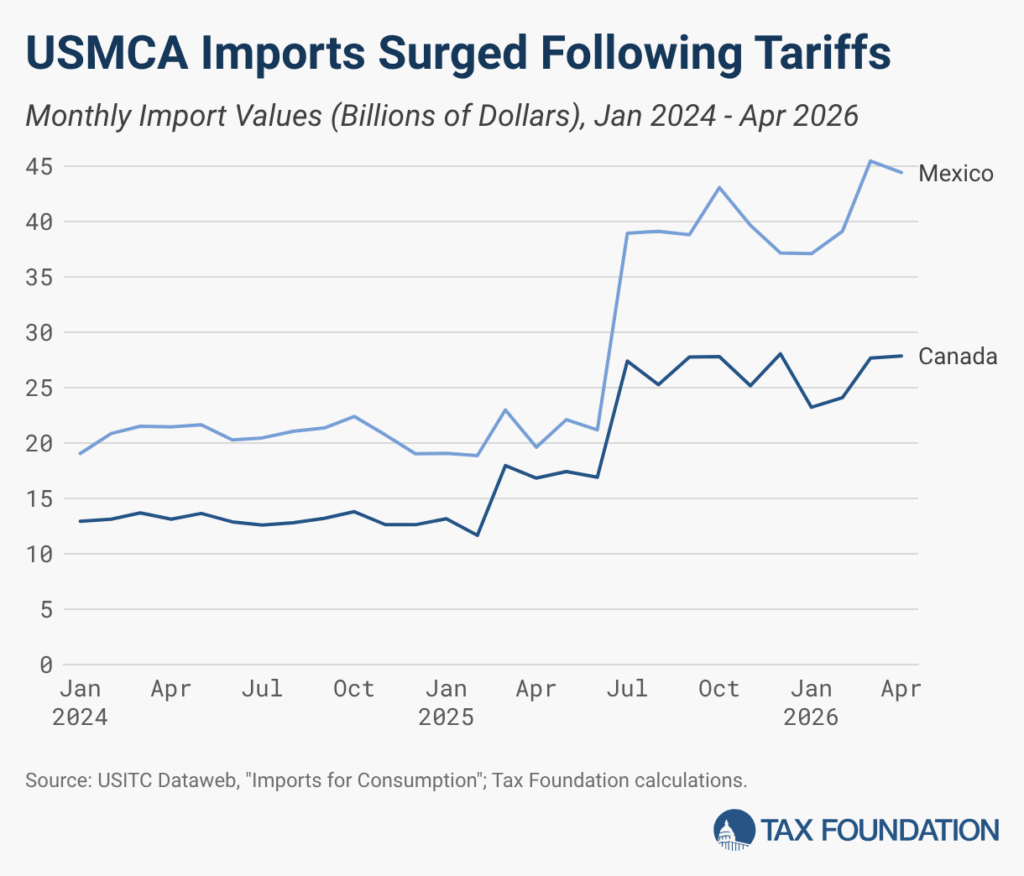
Because USMCA-compliant goods were exempted, importers had a stronger incentive to file compliance paperwork. Between June and July 2025:
- USMCA-compliant imports from Mexico rose 83%
- USMCA-compliant imports from Canada rose 62%
- The compliant share of imports from Canada and Mexico rose from 44% in 2024 to 67% in 2025
- Compliance peaked at 89% in October 2025
- The compliant share has remained above 80% so far this year
The exemption has partly shielded US importers from the tariff shock, although some imports still face Section 232 tariffs, including Canadian and Mexican steel and aluminum.
Economic impact of ending exemptions
The Tax Foundation modeled a scenario in which USMCA exemptions end. In that scenario:
- USMCA imports currently shielded from Section 232 tariffs on autos, auto parts, and trucks would face a 25% tariff
- Other USMCA imports would face a 10% tariff
The analysis estimates that tariffs already in place will cost American households about $700 this year and reduce long-run GDP by 0.3%.
Ending USMCA tariff exemptions would add further costs:
- Long-run GDP would fall by an additional 0.1%
- The US economy would lose 95,000 jobs
- The policy would amount to a $466 billion tax increase from 2027 through 2036
- The cost would be roughly $300 per US household in 2027
Main risk
The current Section 122 tariff is set to expire in July, while Section 301 tariffs are also pending. If USMCA renewal stalls or the agreement is weakened, tariff uncertainty could rise further.
The article argues that withdrawing from USMCA or failing to renew it would add new uncertainty and increase the risk of higher trade barriers. With almost 2 million US jobs supported by trade with Canada and Mexico, the agreement remains an important part of the North American economy.
Source article: taxfoundation.org




