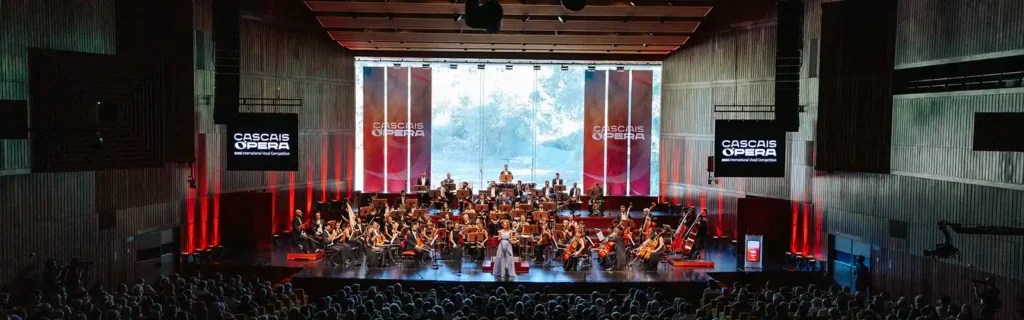
Cascais Opera has become a growing international opera competition in Portugal, combining cultural programming in Cascais and Lisbon with professional development for emerging singers and support from Portugal’s wider cultural funding ecosystem.
In June, 41 singers from 25 countries travelled to Portugal for the latest edition of Cascais Opera. They were selected from 499 applicants representing 59 countries. The competition took place in Cascais before the final moved to the Gulbenkian Foundation in Lisbon on 7 June.
The event brings young singers before jury members and cultural decision-makers from major opera houses and festivals. The jury has included figures connected to institutions such as the Wiener Staatsoper, Glyndebourne Festival, and leading opera institutions in Berlin, Munich, Valencia, Portugal, and Turkey.
Why Cascais Opera was created
Cascais Opera was co-founded by Alexandra Maurício, baritone Sergei Leiferkus, and pianist Adriano Jordão. The idea emerged from the view that Portugal had festivals dedicated to theatre, music, and dance, but lacked a major international competition focused specifically on opera.
Cascais was chosen as part of the competition’s identity. The event is designed to connect artists, jury members, visitors, and supporters with the cultural setting of Cascais and Lisbon, including architecture, history, venues, rehearsals, performances, and informal professional encounters.
International recognition
Cascais Opera joined Opera Latinoamérica after its inaugural edition in 2024. In 2025, after two editions, it was accepted into the World Federation of International Music Competitions.
That recognition placed the competition alongside longer-established international music competitions, despite Cascais Opera being only in its third edition.
Support for singers beyond prizes
The competition is structured to provide value even to singers who do not win. Eliminated contestants may remain involved through:
- Immediate jury feedback
- Voice masterclasses
- Stage movement sessions
- Career workshops
- Coaching on presentation, dress, and CV preparation
The goal is to help singers understand why they did not advance, what they can improve, and how to continue developing professionally.
Cascais Opera is also preparing to launch the Cascais Opera Academy in 2027. The academy is intended to expand the competition’s professional training component. Its masterclasses will be led by mezzo-soprano Jennifer Larmore, who has been appointed Artistic Director of the programme.
Career impact
For contestants, the opportunity to perform before casting directors and artistic leaders can be as important as winning a prize. The article gives the example of Teresa, a young Portuguese singer who reached the final in the first edition but did not win one of the principal awards.
A few weeks later, Robert Körner, casting director of the Wiener Staatsoper, invited her to audition for the Young Artists Programme. She passed the audition and went on to perform and train at the Wiener Staatsoper.
Cultural funding and Portugal’s Golden Visa pathway
The article links Cascais Opera to the broader role of private capital in cultural institutions. It notes that governments remain important supporters of culture, but private investment can also help sustain artistic projects and heritage institutions.
Portugal’s Golden Visa cultural contribution pathway is presented as one modern funding route. Since its launch in 2015, the pathway has directed millions of euros toward artistic and cultural initiatives in Portugal, including film production, performing arts, museum preservation, and archaeological projects.
The article says interest in the cultural contribution route has grown as investors look for residency options connected to cultural and social impact. Through approved cultural projects and institutions, private capital can support artist development, heritage preservation, and cultural organisations that may otherwise struggle to secure long-term funding.
Investor and supporter experience
Supporters of Cascais Opera through Portugal’s cultural contribution pathway may engage with the project beyond financial support.
The article describes an immersive cultural experience in which supporters can attend concerts and rehearsals, meet artists and jury members, and experience Cascais and Lisbon through cultural institutions. The experience is framed broadly, including literature, theatre, performing arts, architecture, landscape, and gastronomy.
One supporter, Ms Sunny Dupree, attended the 2026 competition and described the event as “an exceptional experience,” praising the quality of the young singers in the Lisbon final.
Practical significance
Cascais Opera illustrates how a relatively new cultural institution can use international networks, professional training, and private support to create opportunities for emerging artists.
For singers, the value lies not only in prizes but also in exposure to casting directors, feedback, and career development. For Portugal, the competition contributes to the country’s cultural profile and connects Cascais and Lisbon with a wider international opera network.
Source article: www.globalcitizensolutions.com




