A recent argument claims that full expensing neutralizes the burden tariffs place on imported business equipment and inputs. The counterargument is that tariffs still raise the cost of investment even when businesses can immediately deduct investment costs, and that repealing tariffs would reduce the cost of capital more effectively.
In 2025, the Trump administration implemented policies affecting investment costs in the United States. The One Big Beautiful Bill Act introduced:
- permanent 100% bonus depreciation for short-lived assets;
- expensing for research and development expenses;
- temporary bonus depreciation for manufacturing structures.
These provisions allow firms to fully and immediately deduct certain investment costs, eliminating the income tax burden on new investment in those cases.
At the same time, the administration imposed large, broad-based tariffs on goods imports, including:
- intermediate goods used in production;
- capital goods such as machinery.
The core issue is that expensing and tariffs affect investment in different ways. Expensing lowers the tax burden on investment, while tariffs raise the acquisition cost of imported goods.
Why expensing does not erase tariffs
The argument for tariffs as compatible with low taxes relies partly on the idea that tariff costs can be deducted along with the rest of the capital asset. The article rejects that conclusion.
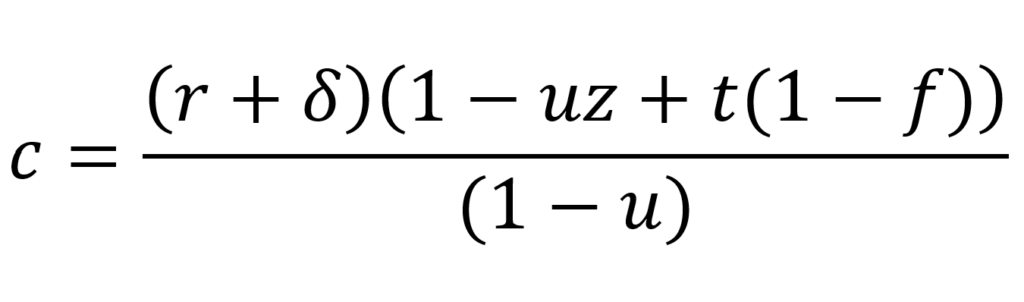
Even when a tariff is deductible, the tariff still increases the cost of the investment itself. A 10% tariff raises the cost of an investment by 10%. Full expensing can eliminate the corporate income tax burden on the investment, but the tariff burden remains.
In the article’s formulation, the cost of capital is generally:
- higher when corporate income taxes apply;
- higher when tariffs apply;
- lower when depreciation deductions are more valuable.
Under full expensing, the corporate tax term may cancel out, but the tariff term remains. Therefore, the investment is still burdened by the tariff.
Tariffs can outweigh the benefit of expensing
The article also argues that even relatively low tariffs can impose a larger effective tax burden on investment than the corporate income tax.
The reason is that tariffs apply to the full value of the investment, while the corporate income tax applies only to net returns.
One example uses a firm with a 5% discount rate importing a machine that depreciates at 20% per year. Before the OBBBA, the present value of depreciation deductions is described as 80%.
Under prior law:
- statutory corporate tax rate: 21%;
- statutory tariff rate: 0%;
- depreciation value: 80%;
- effective tax rate: 21%.
Under OBBBA without a tariff:
- statutory corporate tax rate: 21%;
- statutory tariff rate: 0%;
- depreciation value: 100%;
- effective tax rate: 0%.
Under OBBBA with a 10% tariff:
- statutory corporate tax rate: 21%;
- statutory tariff rate: 10%;
- depreciation value: 100%;
- effective tax rate: 33.3%.
In this example, a 10% tariff produces a higher effective tax rate on the imported investment than the prior 21% corporate income tax treatment, even though the tariff’s statutory rate is less than half the corporate tax rate.
The article notes that this example may not overstate the issue because many imported assets eligible for bonus depreciation, such as computer equipment and machinery, have high depreciation rates, and Trump’s tariffs are generally at least 10%.
It also notes that the benefit of OBBBA expensing may be smaller than the example suggests. Before OBBBA, short-lived investment still qualified for 40% bonus depreciation in 2025 and 20% bonus depreciation in 2026. Even after a scheduled phaseout, MACRS depreciation was slightly more accelerated than economic depreciation.
Some tariffed inputs receive no expensing benefit
The article also argues that tariffs can burden investment even where no full expensing applies.
Non-manufacturing structures, including residential property, do not qualify for expensing. Although residential structures themselves are not imported, intermediate goods used to build them can be imported.
For example, lumber used in construction may face import duties. Higher lumber costs can indirectly raise the cost of residential structure investment, while the structure itself receives no offsetting expensing benefit.
Main conclusion
The article’s conclusion is that there is no low-tax case for tariffs. Full expensing reduces or eliminates the income tax burden on qualifying investment, but it does not neutralize tariffs on imported capital goods or intermediate goods.
The simpler way to reduce the cost of capital, according to the article, is to repeal the tariffs.
Source article: taxfoundation.org





