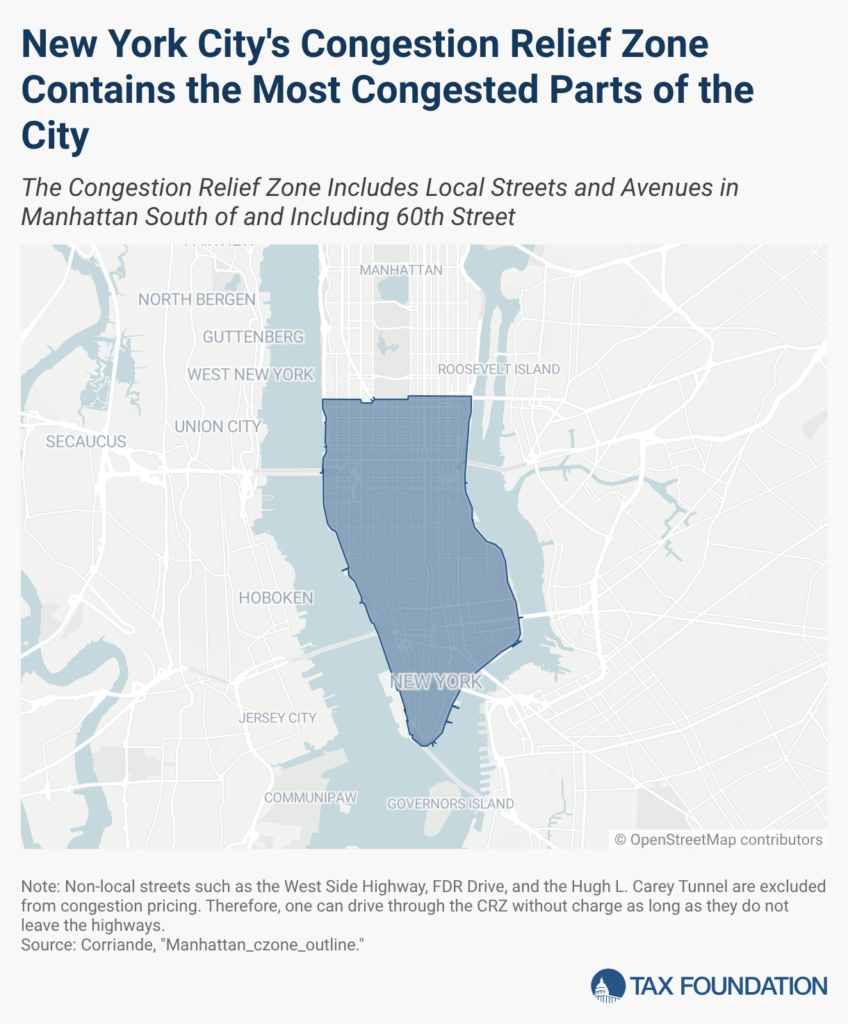
New York City’s congestion pricing, launched in January 2025, is the first large‑scale U.S. program that charges drivers for entering the most traffic‑heavy parts of the city. The scheme was introduced to address record‑high congestion—102 hours of delay per driver in 2024, the worst in the United States—and an $8.3 billion deficit faced by the Metropolitan Transportation Authority (MTA) that year.
Program design
-
Charge rates (per entrance):
- Large trucks and sightseeing buses – $21.60
- Motorcycles – $4.50
- Taxis – $0.75 (per entrance)
- Rideshare vehicles – $1.50 (per entrance)
- Most other vehicles – $9 (capped at one charge per day)
-
Time‑of‑day pricing:
- Peak – 5 a.m. to 9 p.m. on weekdays and 9 a.m. to 9 p.m. on weekends; full toll applies.
- Off‑peak – 75 % discount on the listed rates.
-
Enforcement: Entry into the Congestion Relief Zone (CRZ) is recorded automatically through E‑ZPass transponders and a network of more than 1,400 license‑plate scanners, minimizing traffic disruption while ensuring compliance.
Early outcomes (2024 vs 2025)
- Vehicle entries into the CRZ fell 11 %, while transit ridership rose 9 %.
- Average vehicle speeds inside the CRZ increased 4.6 %, and speeds on crossings into Manhattan rose 23 %.
- Emergency medical service response times improved by an estimated 5–6 % (63–70 seconds).
- Traffic shifted toward the hours just before and after the peak toll window; all other periods saw reduced travel.
- Monthly revenue averaged $55 million, enabling the bonding of $15 billion for the MTA’s capital plan.
Legal challenge
In February 2025, the U.S. Secretary of Transportation, Sean Duffy, sought to withdraw federal approval and funding for the program, alleging violations of federal restrictions. A lawsuit was filed; the district court rejected the attempt to halt the program, and the case now awaits review by the 2nd Circuit Court of Appeals.
Broader implications
Congestion pricing functions as both a user fee—covering road wear and infrastructure costs—and a Pigouvian tax, internalizing the external harms of traffic congestion and pollution. While the NYC experience shows measurable reductions in congestion, revenue generation, and public‑health benefits, its applicability to other U.S. cities is uncertain. New York’s unique combination of a large population, severe traffic congestion, extensive mass‑transit network, and dense employment centers distinguishes it from many American metros that are currently grappling with post‑pandemic downtown revitalization. Consequently, policymakers in other cities should weigh these contextual differences before adopting similar schemes.
Source article: taxfoundation.org


