Retail‑price‑based tax incidence targets, such as the World Health Organization’s (WHO) recommendation that excise taxes equal at least 75 % of the final price of cigarettes, are a poor basis for effective tobacco tax policy.
Why the 75 % incidence target is problematic
- Inconsistent definition – The WHO’s Technical Manual counts all taxes (import duties, excise duties, and value‑added taxes) in the 75 % figure, but only when cigarettes are imported. In other contexts the guidance shifts to focus solely on excise duties.
- Limited global relevance – Of the 178 countries for which the WHO reports data, only 39 (22 %) meet the 75 % incidence threshold. Among those, 25 are classified as high‑income by the World Bank, and 20 of the high‑income cases are EU members. The benchmark therefore reflects the tax structures of wealthy economies rather than the broader world.
Tax incidence versus tax burden
Tax incidence is calculated as total taxes ÷ retail price. Because the denominator includes pre‑tax costs (manufacturing, distribution, competition‑driven pricing) that governments cannot control, the same incidence percentage can represent vastly different absolute tax amounts across countries. Consequently:
- A high incidence can coexist with a low absolute tax burden (e.g., Bangladesh).
- A low incidence can coexist with a high absolute tax burden (e.g., Germany).
Targeting a specific tax rate is more effective
- Revenue focus – Tax revenue depends on the absolute tax rate, not on the share of the retail price.
- Behavioral impact – Higher prices generally reduce legal cigarette sales, but the magnitude of the effect is better predicted by the absolute tax amount rather than a percentage of price.
Risks of raising tax rates without nuance
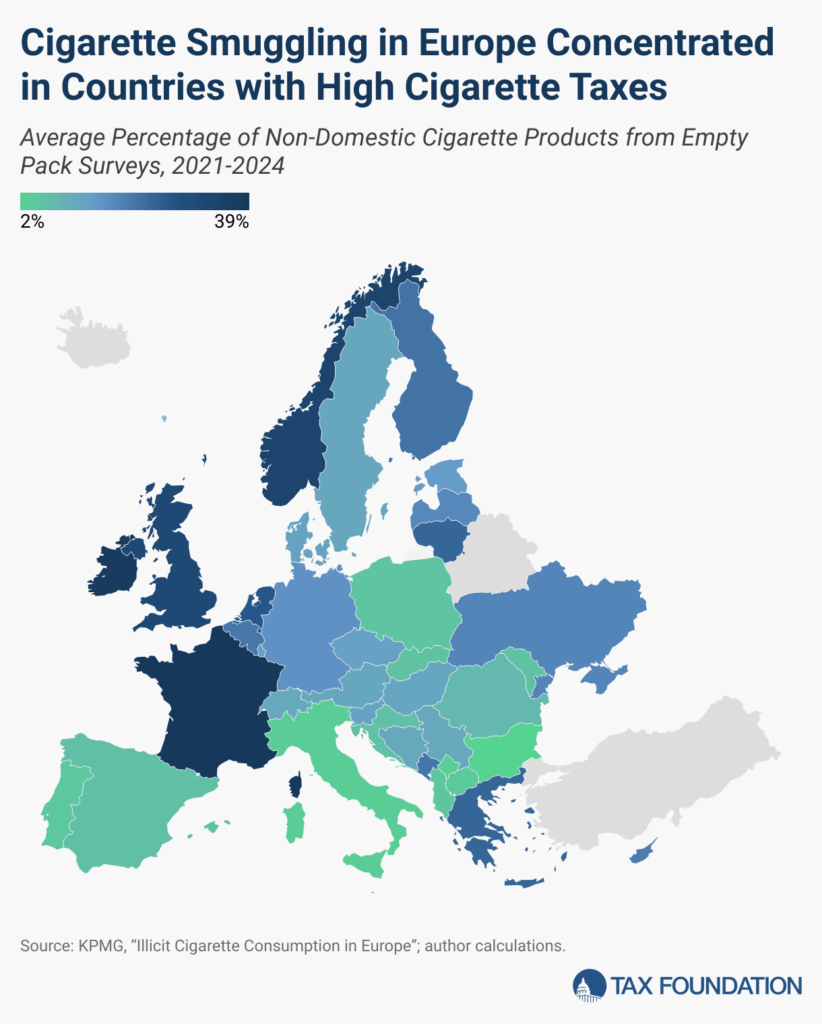
- Illicit trade – Higher excise rates encourage cross‑border purchases, smuggling, and counterfeit markets. In the EU, more than 10 % of cigarettes consumed in 2025 were counterfeit or contraband, costing Member States about €16.7 billion in lost taxes.
- Smuggling correlation – An additional €1 tax per 20‑cigarette pack raises smuggling by roughly 7 % across the EU.
- Limited public‑health gains – In Ireland, the highest EU cigarette tax (€10.71 per pack) has not driven smoking prevalence below the target of 5 %; rates remain around 17 %.
Policy recommendations
- Set explicit tax rates in local currency rather than aiming for a retail‑price share.
- Design broad tax bases with moderate rates to maximize revenue while limiting incentives for evasion.
- Monitor and combat illicit markets through stronger enforcement and cross‑border cooperation, especially when tax hikes are planned.
- Consider socioeconomic impacts – Since tobacco consumption is higher among lower‑income groups, steep tax increases can exacerbate financial strain without proportionate health benefits.
- Promote lower‑risk alternatives (e.g., regulated nicotine‑replacement products) as part of a comprehensive tobacco‑control strategy.
By focusing on controllable levers—specific excise rates, robust tax design, and enforcement—policymakers can better achieve revenue goals and public‑health objectives without the unintended consequences associated with a one‑size‑fits‑all incidence target.
Source article: taxfoundation.org


