
Capital allowances determine how much of a business investment can be deducted from taxable revenue through depreciation. Across the OECD, businesses recover an average of 70.1 percent of their capital investment costs in real terms, but treatment varies sharply by country and asset type. Temporary and permanent full-expensing measures introduced in 2025 improved average cost recovery after declines in 2023 and 2024.
A capital allowance is the portion of an investment cost that a business may deduct each year. Full expensing permits the entire cost to be deducted in the year an asset is acquired, while conventional depreciation spreads deductions over several years.
Because deductions received in later years lose value through inflation and the time value of money, a business may nominally deduct the full purchase price of an asset while recovering substantially less in real terms. This raises measured taxable profits and increases the effective cost of investment.
OECD capital cost recovery
On average, OECD businesses can recover:
- 86 percent of machinery investment costs
- 78.2 percent of intangible investment costs
- 50.3 percent of industrial building investment costs
- 70.1 percent across the three asset categories combined
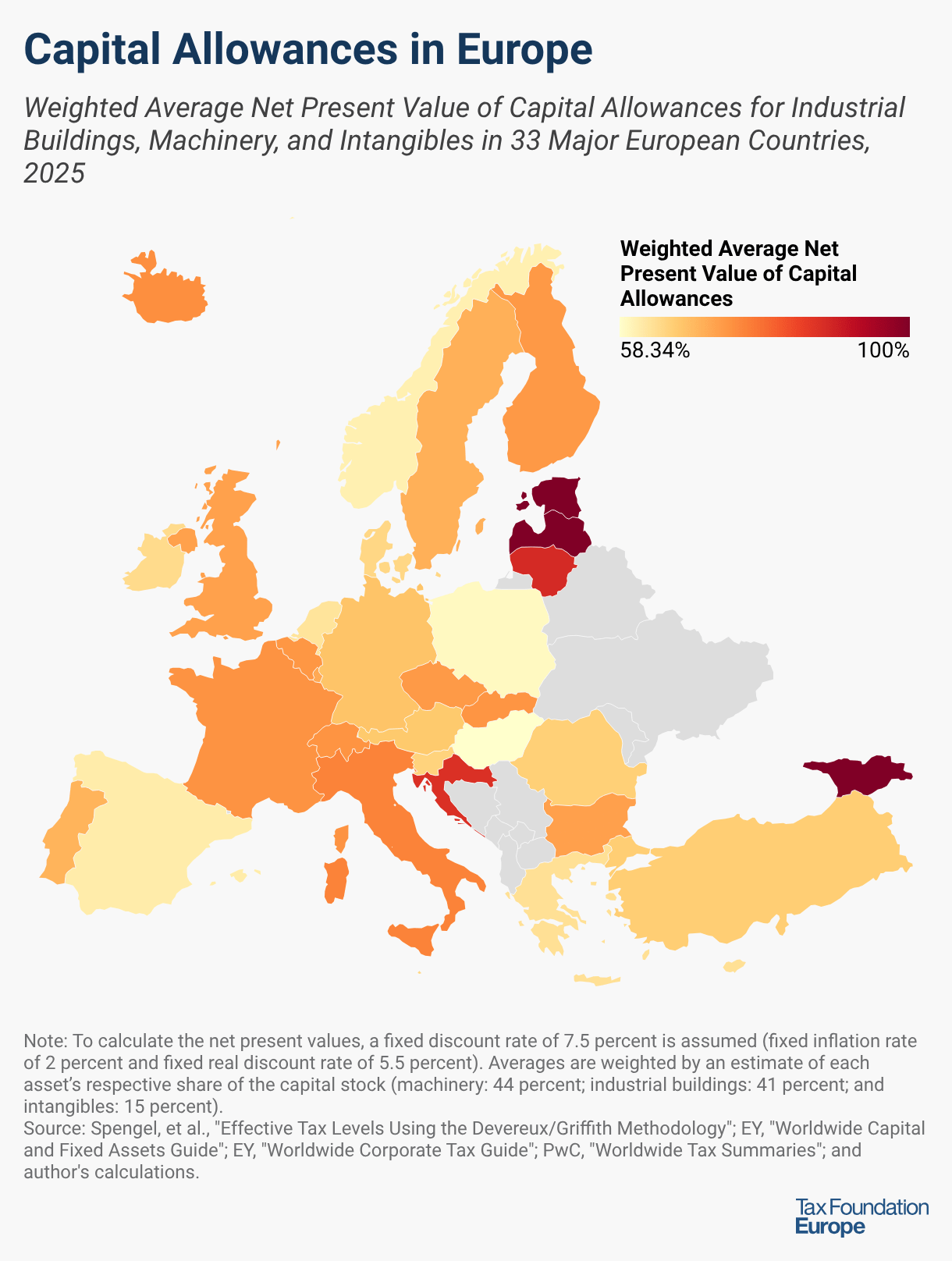
Estonia and Latvia provide 100 percent capital cost recovery because their cash-flow corporate tax systems tax profits only when they are distributed to shareholders. At the other end of the ranking, Chile allows businesses to recover an average of 48.4 percent of investment costs, while New Zealand allows 49.1 percent.
The report’s weighted averages assume that machinery represents 44 percent of the capital stock, industrial buildings 41 percent, and intangibles 15 percent. Calculations use a 7.5 percent discount rate, consisting of 2 percent inflation and a 5.5 percent real discount rate.
Industrial buildings receive the least favorable treatment. Estonia and Latvia allow full recovery, while Costa Rica, Hungary, and Japan allow 27.9 percent and New Zealand allows 20 percent.
Machinery generally receives the most favorable treatment. The United Kingdom, United States, Canada, Estonia, and Latvia provide 100 percent cost recovery. Chile allows 70.6 percent, while Colombia, Greece, and Poland each allow 73.8 percent.
For intangible assets, Estonia, Latvia, and Canada provide 100 percent recovery. Australia, New Zealand, and Portugal each allow 54.8 percent, while the United States allows 63.3 percent. Chile does not provide allowances for intangible assets.
Why delayed deductions lose value
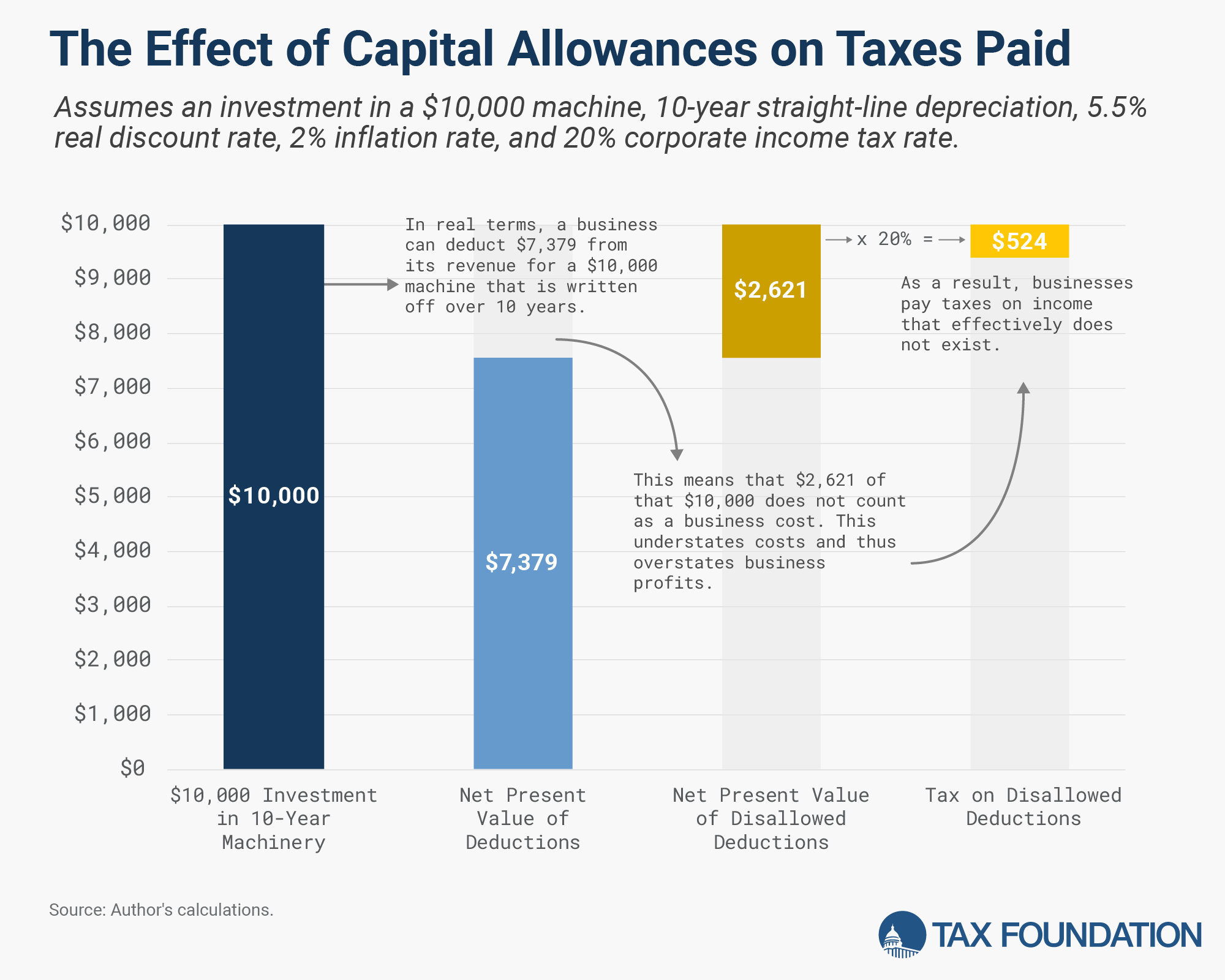
Consider a machine costing $10,000 with a 10-year straight-line depreciation schedule. The business deducts $1,000 annually, but later deductions are worth less in current terms.
With inflation of 2 percent and a required real return of 5.5 percent, the final $1,000 deduction is worth only $522 in present-value terms. Across the full period, the business recovers $7,379 in present value, or 73.8 percent of the original investment.
Longer depreciation periods, higher inflation, and higher interest rates reduce cost recovery further. A capital cost recovery rate of 100 percent means the business can recover the full investment cost, including the effects of inflation and a normal return. A rate below 100 percent means taxable income is effectively overstated.
Inflation reduces the value of allowances
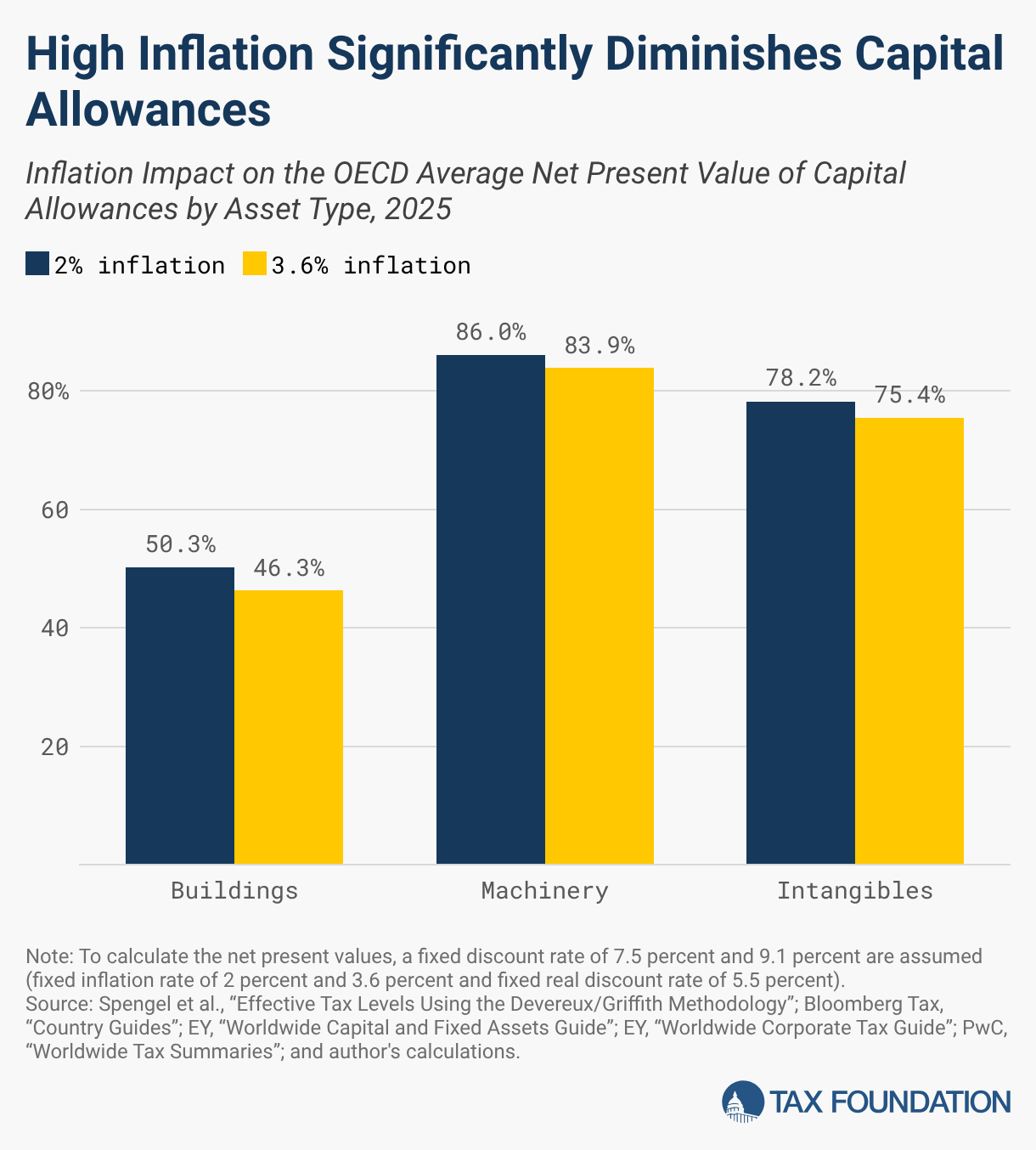
The report uses a standard inflation assumption of 2 percent, but OECD inflation averaged 3.6 percent in 2025. At that rate, average OECD cost recovery falls to:
- 46.3 percent for buildings
- 83.9 percent for machinery
- 75.4 percent for intangibles
Raising inflation from 2 percent to 3.6 percent reduces recoverable investment costs by as much as approximately four percentage points.
Mexico, Israel, and Chile are the only OECD countries that adjust capital allowances for inflation. These adjustments preserve more of the real value of deductions and partially offset the disadvantages of long depreciation schedules.
Effects on investment and economic growth
Lower capital allowances increase the cost of capital and can reduce investment, productivity, employment, and wages. They can also distort the composition of investment by giving different tax treatment to machinery, buildings, and intangible assets.
Research cited in the report found:
- US bonus depreciation increased investment in eligible capital relative to ineligible capital by 10.4 percent between 2001 and 2004 and by 16.9 percent between 2008 and 2010.
- Accelerated depreciation introduced in the United Kingdom in 2004 increased the investment rate of qualifying companies by an estimated 2.1 to 2.5 percentage points relative to companies that did not qualify.
- Under a scenario with a 22 percent corporate tax rate, a 25 percent depreciation rate, and 2 percent inflation, a one-percentage-point increase in inflation reduced the optimal level of investment by 0.42 percent.
- A 2024 study found that US corporate tax reductions and full expensing increased domestic investment by 20 percent for companies experiencing the mean tax change, compared with companies experiencing no change.
Differences in allowances can redirect investment between sectors. More generous treatment of machinery may encourage manufacturing investment, while poor treatment of buildings can discourage long-term construction and industrial projects.
The United Kingdom’s experience during the 2010s is cited as an example of cutting corporate tax rates while lengthening asset lives. The combination reduced allowances for capital-intensive businesses and was associated with weaker business investment.
Recent changes across the OECD
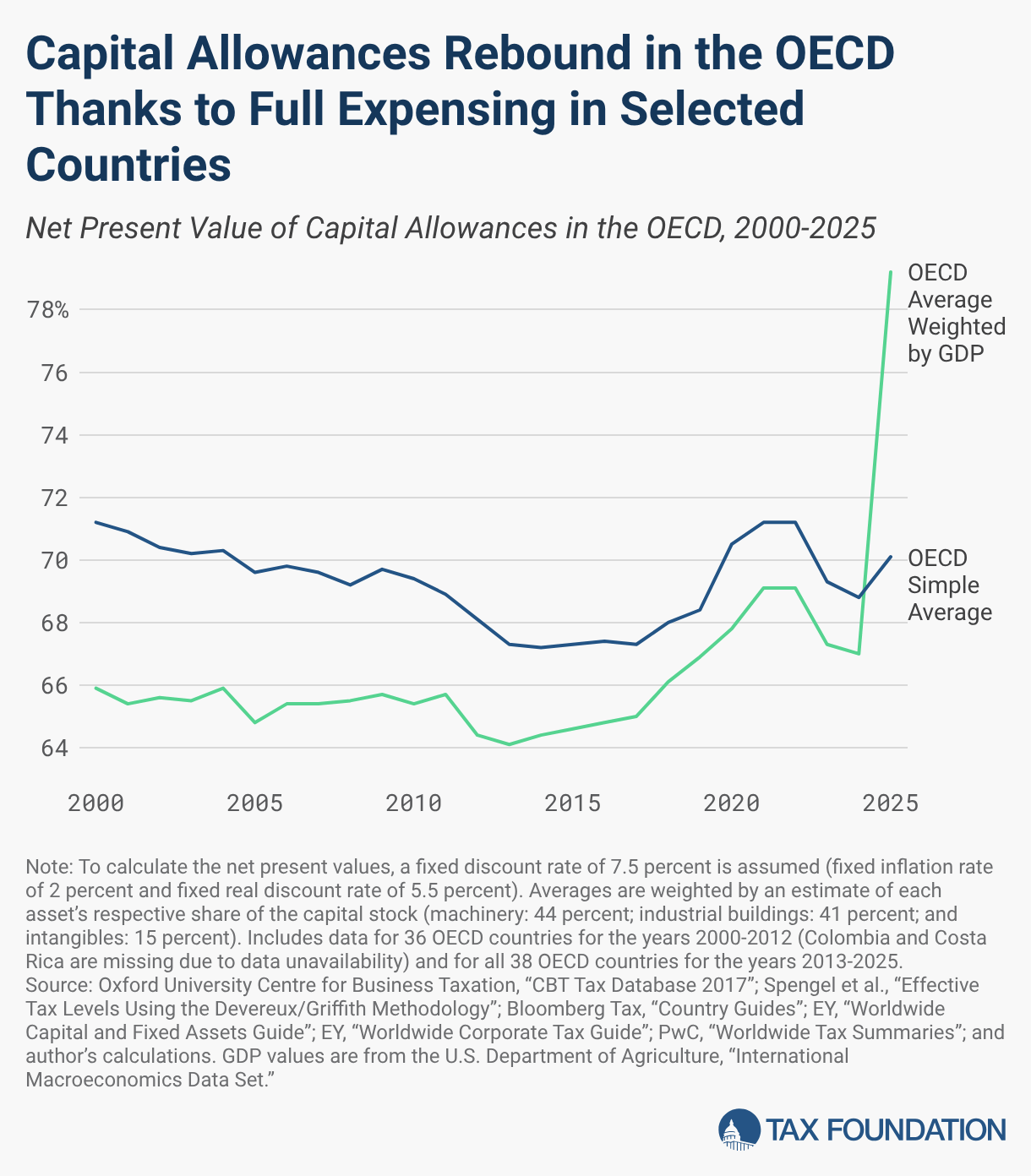
The average OECD capital cost recovery rate declined from 71.2 percent in 2000 to 67.2 percent in 2014. It later recovered, reached 71.2 percent in 2022, fell to 68.8 percent in 2024, and rose to 70.1 percent in 2025.
When weighted by national GDP, the average declined from 65.9 percent in 2000 to 64.1 percent in 2013, rose to 69.1 percent in 2022, fell to 67 percent in 2024, and then increased sharply to 79.2 percent in 2025.
The 2025 increase was driven largely by full-expensing measures in the United States and Canada and enhanced allowances in Germany and New Zealand. Smaller economies had historically provided better treatment, but the United States and Canada rose to third and fifth place, respectively, in 2025.
Temporary accelerated depreciation measures
Several OECD countries introduced or extended accelerated depreciation policies following the pandemic and subsequent weak economic growth.
Australia
Small businesses with revenue below AUD 10 million can immediately deduct assets costing less than AUD 20,000. The 2026-2027 budget announced that the measure would become permanent. Without an extension or permanent implementation, the existing measure was due to expire on 30 June 2026.
Austria
Austria accelerated building depreciation during the first two years and permits higher-rate declining-balance depreciation for machinery. Assets costing less than EUR 1,000 can be immediately written off.
Denmark
Denmark provides enhanced deductions for research and development expenses. The deduction was:
- 130 percent in 2021
- 105 percent in 2022
- 108 percent from 2023 through 2025
- 110 percent from 2026 onward
Eligible expenses may be deducted immediately or over five years. Denmark also permits immediate write-offs for qualifying assets costing less than DKK 34,400 in 2025 or with useful lives of no more than three years.
Finland
Finland doubled the declining-balance depreciation rate for machinery from 25 percent to 50 percent for 2020 through 2023 and later extended the measure through 2025.
Germany
Germany applied accelerated machinery depreciation from 2020 through 2022. The policy expired in 2023, was partially renewed for 2024, and was subsequently increased and extended through 2027. Accelerated depreciation for dwellings is available through 2029, and immediate write-offs were permanently increased for assets costing less than EUR 800.
New Zealand
New Zealand temporarily restored depreciation for commercial and industrial buildings from 2020 through 2023, then abolished it again in 2024. Its 2025 Budget introduced an immediate deduction equal to 20 percent of the cost of new assets, including industrial buildings, with no stated end date.
Norway
Since 2022, Norway has permitted an immediate deduction against the special oil-tax base for new fixed assets used in qualifying extractive activities.
United Kingdom
The United Kingdom allowed a 130 percent deduction for plant and equipment and a 50 percent deduction for certain other investments from April 2021 through March 2023. The 130 percent super-deduction was replaced by permanent full expensing.
Temporary allowances can cause businesses to bring planned investments forward without permanently increasing investment levels. Permanent full expensing provides greater certainty for long-term projects.
Country comparisons
Estonia and Latvia
Estonia and Latvia tax corporate profits when they are distributed rather than when they are earned. Their corporate tax rates are 22 percent and 20 percent, respectively.
Because retained profits and investment costs are not subject to conventional annual taxable-income calculations, businesses effectively receive immediate deductions for investment. This produces a 100 percent capital cost recovery rate and removes the need for conventional depreciation schedules.
United States
The United States allows businesses to recover an average of 94.5 percent of capital investment costs, 24.4 percentage points above the OECD average.
Its cost recovery rates are:
- 100 percent for machinery
- 63.3 percent for intangibles
- Temporary 100 percent expensing for qualifying industrial structures
Permanent full expensing for machinery was adopted in 2025 after bonus depreciation introduced under the 2017 Tax Cuts and Jobs Act began phasing down in 2023.
Qualifying structures may receive full expensing when construction begins after 19 January 2025 and before 1 January 2029 and the property is placed in service before 1 January 2031. The provision covers close to all industrial buildings but approximately 10 to 15 percent of total US buildings and structures.
Tax Foundation estimates cited in the report project that permanent machinery expensing will increase long-term GDP by 0.6 percent and the capital stock by 1 percent.
Canada
Canada reinstated temporary full expensing for manufacturing and processing machinery, equipment, and qualifying clean-energy investments in 2025.
It also provides accelerated deductions for non-residential buildings and intangibles:
- Manufacturing and processing buildings receive a 15 percent first-year write-off, up from 10 percent.
- Other non-residential buildings receive a 6 percent first-year write-off, up from 4 percent.
- The declining-balance rate for patents increased from 5 percent to 7 percent.
The enhanced deductions were initially scheduled to phase out between 2024 and 2027. They were reinstated in 2025 and will remain in place through 2029, followed by a gradual phaseout from 2030 through 2033.
Immediate expensing also applies to patents, data-network infrastructure, general-purpose electronic data-processing equipment, and systems software acquired after 15 April 2024 and available for use before 2027.
United Kingdom
UK businesses could deduct 130 percent of plant and equipment costs between April 2021 and March 2023. The policy was introduced during the transition from a 19 percent corporate tax rate to the current 25 percent rate.
The super-deduction was replaced in 2023 with 100 percent full expensing. A 50 percent first-year allowance applies to certain integral building features and long-life assets that do not qualify for full expensing.
The Annual Investment Allowance provides full first-year relief for up to GBP 1 million of plant and machinery investment and is permanent. Full expensing and the 50 percent first-year allowance were also made permanent in the 2023 Autumn Statement.
Without permanent full expensing, the UK would have returned to an 18 percent declining-balance allowance, equal to a 75.8 percent deduction in present-value terms. Model estimates cited in the report project that permanent expensing will raise GDP by 0.9 percent, investment by 1.5 percent, and wages by 0.8 percent compared with a return to pre-2021 rules.
Lithuania
Lithuania introduced permanent full expensing for machinery, equipment, software, and acquired rights from 1 January 2026. The report’s comparative data reflect 2025 policies, so this reform is not included in the current rankings.
Corporate tax rates and allowances
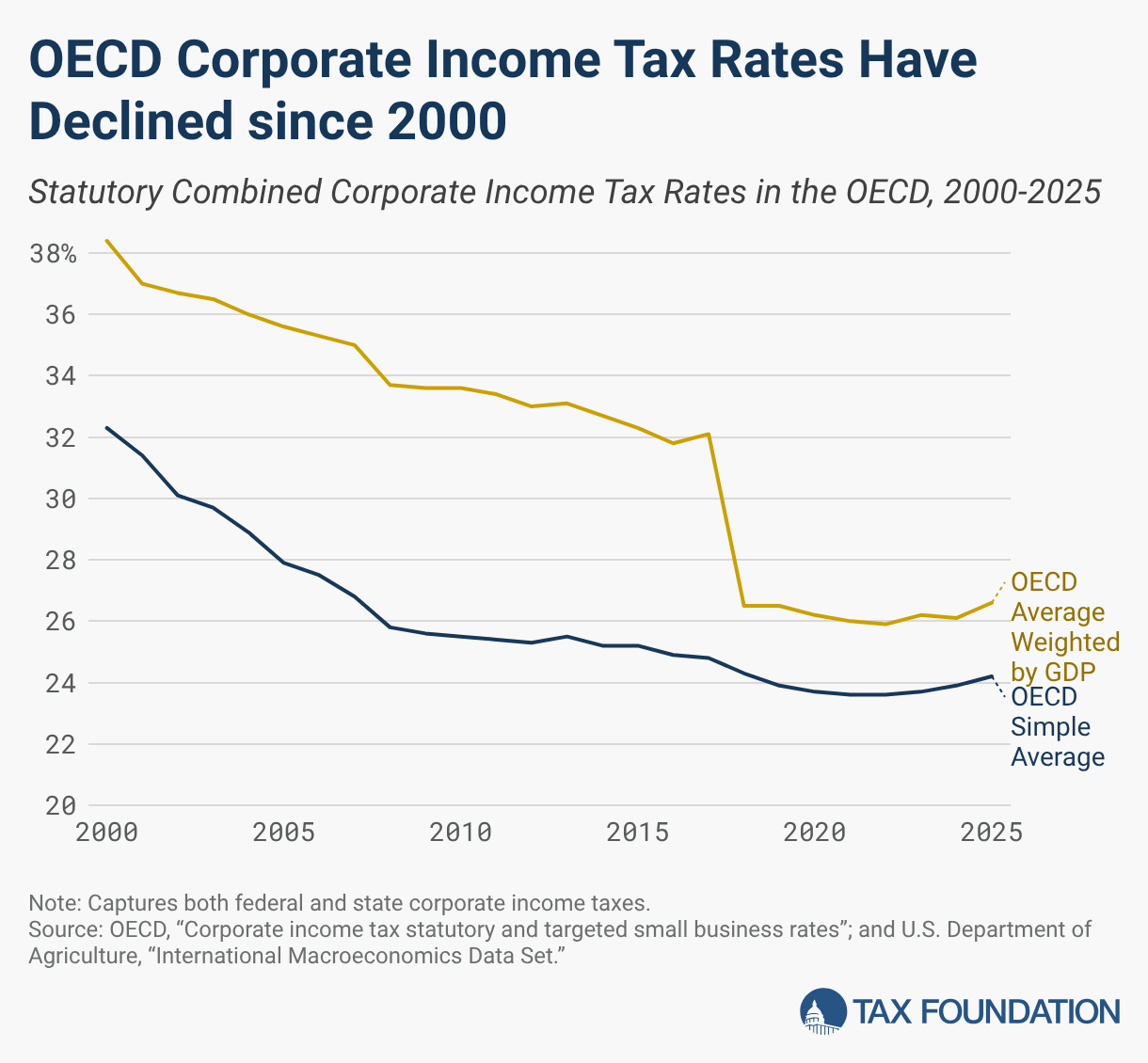
The average statutory corporate income tax rate in the OECD declined over the past 25 years, reaching approximately 23.9 percent in 2024 before increasing slightly to 24.2 percent in 2025.
The GDP-weighted OECD rate also declined, particularly after the US corporate tax reduction in 2017, and stood at approximately 26.6 percent in 2025.
Corporate tax rates alone do not determine the tax burden on investment. A lower statutory rate can be offset by a broader tax base and less generous capital allowances. Smaller OECD economies often combine higher capital allowances with lower corporate tax rates, making them comparatively more attractive for investment.
Straight-line and declining-balance examples
Under an eight-year straight-line schedule of 12.5 percent, a business investing $100 deducts $12.50 annually. With a combined real discount and inflation rate of 7.5 percent, the deductions have a present value of $78.71, producing a recovery rate of 78.71 percent.
At 3.6 percent inflation, the combined discount rate rises to 9.1 percent and the present value falls to $75.20.
Under an illustrative declining-balance schedule of 20 percent, the business deducts 20 percent of the remaining asset value each year, with the residual amount deducted in the final year. At a 7.5 percent discount rate, the deductions have a present value of $80.94. At 3.6 percent inflation, the present value falls to $77.83.
Declining-balance depreciation generally provides larger deductions in earlier years than straight-line depreciation, preserving more of the investment’s value.
Unusual depreciation systems
The Czech Republic and Slovakia permit specific accelerated depreciation methods for machinery. The Czech Republic also applies the method to buildings, while Slovakia shifted buildings to straight-line depreciation in 2015.
Under the accelerated method, first-year depreciation is calculated by dividing the cost of the asset by its useful life. Later deductions are based on twice the remaining tax value divided by the remaining years plus one.
Despite the complexity of the system, Slovakia ranks 11th in the OECD comparison with a 73.9 percent recovery rate, while the Czech Republic ranks 14th at 73.3 percent.
Chile, Israel, and Mexico permit inflation adjustments to depreciation allowances. These adjustments preserve a larger share of investment costs in real terms and reduce the penalty created by long depreciation schedules.
Permanent and broadly available capital allowances provide businesses with greater certainty than temporary or narrowly targeted incentives. Full expensing or inflation-adjusted neutral cost recovery can prevent deductions from losing value and reduce tax-system biases against long-term capital investment.
Source article: taxfoundation.org


