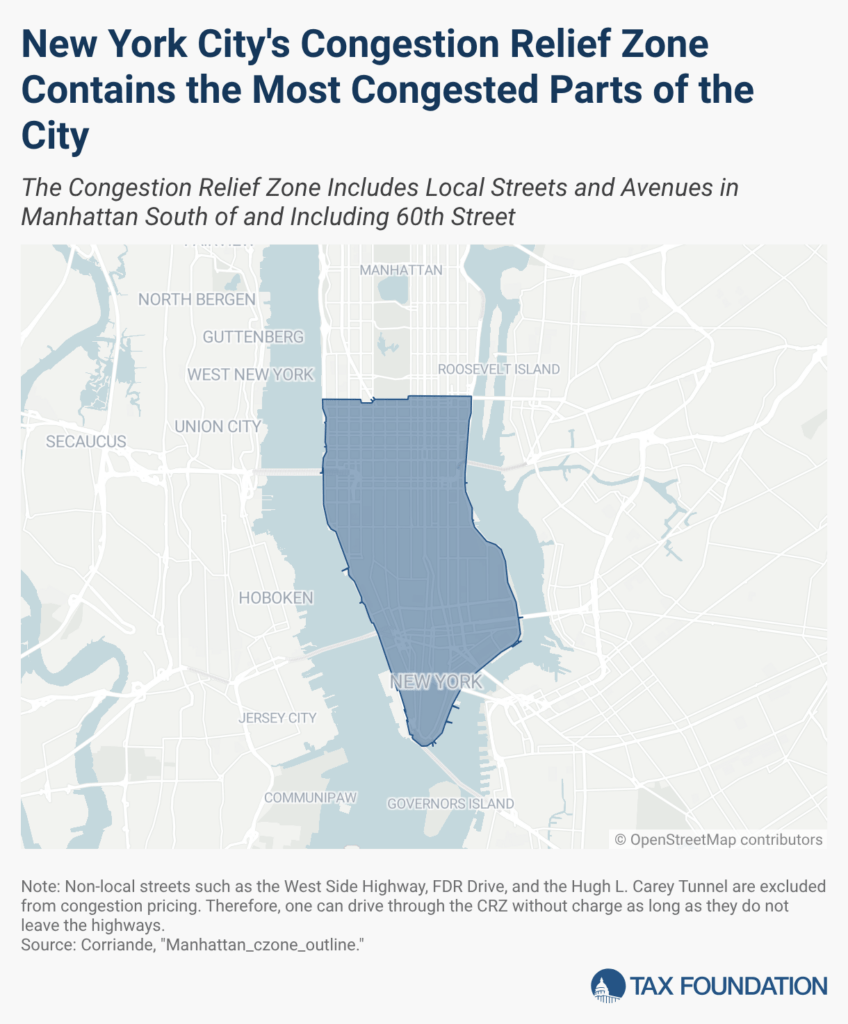
New York City’s congestion‑pricing program, launched in January 2025, imposes a toll on drivers entering the city’s most congested zones. Modeled after schemes in Singapore, Milan and London, the policy aims to generate revenue for the Metropolitan Transportation Authority (MTA) while shifting travel to public‑transit alternatives.
How the toll works
- Base fee: $9 per day for most vehicles.
- Vehicle‑type rates:
- Large trucks and sightseeing buses – $21.60 per entry
- Motorcycles – $4.50 per entry
- Taxis – $0.75 per entry
- Rideshare vehicles – $1.50 per entry
- Time‑of‑day adjustment: Full fee applies during peak periods (weekdays 5 a.m.–9 p.m.; weekends 9 a.m.–9 p.m.). Off‑peak travel receives a 75 % discount.
- Collection method: Entries are recorded via E‑ZPass and a network of more than 1,400 license‑plate scanners, limiting traffic disruption.
Early outcomes (2024 vs 2025)
- Vehicle entries: Down 11 % in the Congestion Relief Zone (CRZ).
- Transit ridership: Up 9 % across the MTA system.
- Average speeds:
- Within the CRZ increased 4.6 %
- On Manhattan crossing routes increased 23 %
- Emergency‑medical response: Estimated 5–6 % faster (63–70 seconds) after the toll’s implementation.
- Revenue: Average monthly toll collection of $55 million, supporting a $15 billion bond issuance for MTA capital projects.
Legal challenges
In February 2025, the U.S. Secretary of Transportation, Sean Duffy, sought to withdraw federal approval and funding, alleging violations of federal restrictions. A lawsuit was filed; the court rejected the attempt to halt the program, and the case now awaits review by the 2nd Circuit Court of Appeals.
Broader considerations
- Economic rationale: The toll functions both as a user fee—covering road wear and infrastructure costs—and as a Pigouvian tax, internalizing the external harms of congestion and pollution.
- Unique context: NYC’s large population, dense job concentration in Lower and Midtown Manhattan, and extensive mass‑transit network differentiate it from most U.S. cities, many of which are still recovering from reduced downtown activity in the work‑from‑home era.
- Potential replication: While the program’s early success has spurred interest in other cities such as Los Angeles and Washington, DC, policymakers must assess local traffic patterns, transit capacity, and economic conditions before adopting similar schemes.
Source article: taxfoundation.org


